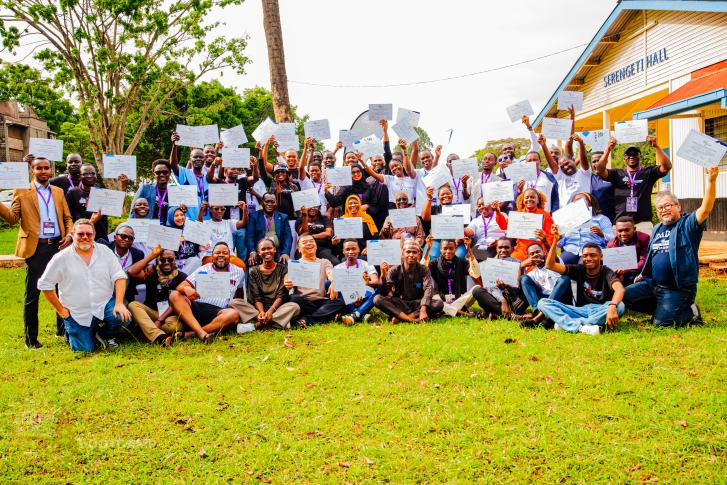


When communities take the lead in addressing their own connectivity needs, knowledge and skills become not only a requirement, but also a shared resource. Training and learning processes allow communities to strengthen their ability to design, deploy and sustain their own communication infrastructures, while also developing the technical, organisational, financial and social capacities needed to let these initiatives thrive and grow.
Building community networks and other local connectivity projects requires much more than technical expertise. It involves understanding energy solutions, governance models, financial sustainability, content creation, and the development of local services that respond to local needs. Capacity building enables communities to create technologies that are appropriate, accessible and reliable, grounded in their own contexts. From hardware and software development to local content production, or even artificial intelligence tools, training processes open the door for communities to shape their own digital futures.
With recent bootcamps in Africa and Latin America to mark the conclusion of editions of the Blended Training for ICT Network Managers in Indigenous and Rural Communities in both regions, plus the upcoming South Africa School of Digital Policy (ZASDIP), this issue focuses on the many ways that communities are strengthening their skills and knowledge to advance digital inclusion. Across different regions, community-led initiatives are developing diverse strategies to build the technical, social, economic and political capacities needed to sustain their projects. Learning remains an ongoing challenge, but also a collective opportunity to improve practices, reinforce collaboration and continue expanding community-driven paths toward meaningful connectivity.
Welcome to the 90th monthly round-up of developments impacting your local access networks and community-based initiatives.
Routing for Communities podcast
The stories narrated in the first season of our Routing for Communities podcast are primarily based on the initiatives that communities undertook to find their own connectivity solutions, aimed at addressing their own needs. The Season 1 episodes reflect the diversity of strategies that communities adopted to address their capacity-building needs, like the Mamaila Community Network in South Africa, the Wiki Katat” Indigenous virtual operator in Mexico (also available in Spanish), and the community network in the Ciptagelar Traditional Village, in West Java, Indonesia. The Routing for Communities podcast also shares the radio party that closed the latest bootcamp in Guatemala.
Find all the episodes here. And remember they are also available on Apple Podcasts, YouTube and Spotify.
Join the journey!
Community networks news and stories
- The first edition of the Blended Training for ICT Network Managers in Indigenous and Rural Communities held in Africa in 2025 marked an important milestone for the region. A total of 44 participants from 18 countries successfully completed the course and gathered in Nairobi, Kenya for an intensive bootcamp week filled with workshops, training sessions, a public forum and visits to community-centred connectivity initiatives on the ground. Follow the highlights of this experience in this photo journey. Read more.
- The Latin America edition of the Blended Training also ended with the hosting of a bootcamp in Puebla, Mexico. This fifth edition of the course and the bootcamp in the region also featured an open forum on “Telecommunications in Rural Areas and Indigenous Communities in Latin America” as well as a celebration radio programme. Watch this video that synthesises the experience. [Available in Spanish]
- From remote highlands to island communities, Common Room accompanied five experiences across Indonesia, where community networks are redefining connectivity through local knowledge, collective action and innovative models of sustainability. Supported by the LocNet initiative, led by Rhizomatica and APC, these experiences highlight how communities are building not just internet access, but more inclusive, resilient and meaningful digital futures. Read more.
- AlterMundi from Argentina participated in the Encuentro de Tecnologías Libres, a gathering that brought together communities to share collective experiences of knowledge building, with a focus on free/libre and open source hardware and software development. Participants were invited to reflect on what happens when knowledge is shared to build sovereignty. Watch this video about the gathering. [Available in Spanish]
- In Kenya, the Athi Community Network (ATHICN) recently launched a community information portal that hosts agriculture and climate education videos in the Kimeru language. Farmers can access the content free of charge using any Wi-Fi-enabled device within the ATHICN network coverage, with no mobile data required. Read more.
- First launched during the COVID pandemic as a way to amplify the voices of Indigenous peoples and Afro-descendant communities and civil society organisations through virtual means and networking, the Canto de Centzontles community radio series is celebrating five years of work. During this time they have broadcast 200 programmes shared by more than 70 public, university and community radio stations in several different countries. Listen to the episode in which they celebrate this anniversary. Read more. [Available in Spanish]
- Under the Enhancing Digital Access and Community Resilience (EDACR) project, implemented by KICTANet in Kenya, a visit to Samburu County engaged 167 participants, with a special emphasis on youth, women and persons with disabilities, to focus on introducing digital skills and AI literacy, showing how these tools can support livelihoods, improve access to services, and unlock economic opportunities. Read more.
- Also from Kenya, Tanda Community Network recently launched Connected Voices, a new podcast series that explores how community networks are using digital tools to tell their own stories, preserve culture and bridge the digital divide. In the first three episodes, the podcast shares the experiences of the Oasis Mathare, Tanda and Dunia Moja community networks, in the voices of those who build and sustain these initiatives. Find them on Spotify, in YouTube and Afripods.
- Community technicians from BOSCO Uganda ICT sites took on their fear of heights during the Working at Height safety training. Led by experts, they participated in theory and hands-on sessions, covering what working at height means, the jobs it includes, risks and hazards, needed personal protective equipment, safety rules and standards. Read about the theory session and the practical session.
- During the COP30 edition held last year in Belém do Pará, Brazil, the intersection between digital inclusion and environmental justice was brought into focus through special coverage by Rede Wayuri, a local collective of popular communicators. Building on this experience, they share a reflection from the Amazon on the challenges of achieving meaningful connectivity for communities most affected by climate change and environmental harm. Available in Portuguese and Spanish.
- In a world where digital technologies often distance rather than connect people, moments of encounter, shared stories and collective reflection can feel almost magical. Between May and December 2025, REDES A.C. in Mexico fostered this spirit through the “Indigenous Forum for Autonomy and the Political Agenda in Community Telecommunications”, a space for political education, critical analysis and advocacy. Available in English and Spanish.
Gendered experiences
- A new edition of GenderIT focuses on the Feminist Technology Exchange held last year in Nairobi. The edition explores in five articles how communities are navigating the digital divide amidst climate crises, responding to the changing realities of the world, in community-centric pieces, fictionalised storytelling, and reflections on how researchers are adopting a feminist approach to technology rooted in care. Read more.
- “From context to collective action: Outcomes of Africa’s first symposium on technology-facilitated gender-based violence (TFGBV)” is blog post developed by Peace Oliver Amuge and Josephine Miliza following a constructive conversation from the event, sharing the context, collective responsibility, research, initiatives, regulations and a call to action. Read more.
- In Nigeria, the Centre for Information Technology and Development (CITAD) launched Reportrix, an app that aims to combat gender-based violence and fake news. The app offers a secure, multilingual platform to report gender-based violence, misinformation and digital rights violations. Watch this video about the app.
Enabling policy and regulation
- In Colombia, community networks, civil society organisations and academic actors submitted comments on the draft resolution of the Ministry of Information and Communications Technologies (MINTIC) that seeks to initiate the selection process for the allocation of permits for the use of radio spectrum in the 900 MHz band for community-centred connectivity initiatives. Read more. [Available in Spanish]
- Nigeria has launched a formal review of its National Telecommunications Policy 2000, with the Minister of Communications, Innovation and Digital Economy establishing committees to lead the process. A newly released consultation paper marks the first step in a public consultation process that will shape updates to the policy, aiming to address current challenges, keeping pace with technological change over the past 25 years. Read more.
Publications, research and toolkits
- Urban populations navigate sophisticated digital ecosystems, yet millions in rural India encounter computers for the first time. The Digital Empowerment Foundation (DEF) documents initiatives at Alwar district in Rajasthan and Nuh district in Haryana that democratise digital access, emphasising marginalised populations and women’s empowerment. Read more.
- The Unboxing Tech Toolkit is a series of tools developed by the Pranava Institute and Centre for Emerging Technology and Policy designed for young people to explore their relation with technology, aiming to be healthy and safe. The activities in the toolkit uncover the physical infrastructure required to power the internet and unpack the energy it consumes, revealing its environmental costs and what can be done about it. Read more. The toolkit is available in English, Kannada, Filipino and Khmer.
- How is environmental communication researched in and from Latin America? The Faculty of Communication and Image of the University of Chile is inviting proposals for a new edition of the “Comunicacion y Medios” journal devoted to “Environmental Communication in Latin America”. The call aims to reflect on the scope, approaches and dilemmas of research in this field, as well as to share results and methodologies from the perspective of Latin American environmental communication. Read more. [Call available in Spanish and in English]
Events
- The D4D (Digital for Development) Hub Gender and Digital Rights webinar series will host a session on Gender, Digital Rights and Connectivity: Community-Led Solutions for an Inclusive Digital Future on 27 March at 13:00 (UTC+1). Read more.
- From 13 to 16 April, the first edition of the South Africa School of Digital Policy (ZASDIP), community networks edition, will be held in Johannesburg. Read more.
- The 2026 Kenya School of Internet Governance (KeSIG) will be held online from 22 April to 15 May. The deadline to apply is 10 April. Read more
- Organised by Access Now, this year's edition of RightsCon is going to take place in Lusaka, Zambia, from 5 to 8 May 2026. As a hybrid event, it will allow both in-person and online participation. Read more.
- The Digital Rights and Inclusion Forum (DRIF) convened by Paradigm Initiative will be taking place from 14 to 16 April in Cote D'Ivoire. Read more.
- CryptoRave 2026 will be held on 8-9 May in São Paulo, Brazil. It is an open and free event with activities about security, cryptography, hacking, anonymity, privacy and freedom on the internet. Read more. [Available in Portuguese]
- This year's edition of the Africa Tech Policy Summit, organised by KICTANet, will be held from 19 to 21 May in Nairobi, Kenya. Read more.
- The 2026 edition of the Digital Rights Asia-Pacific (DRAPAC) Assembly will be held in Manila from 8 to 10 June. Read more.
- The 2026 Global Gathering is open for applications. It will take place from 4 to 6 September in Estoril, Portugal. Read more.
Funding opportunities
- With the main objective of solving availability, affordability and adoption as the major barriers to meaningful connectivity for communities, the Internet Society Foundation launched its Community-Centered Connectivity Grant Program. Through three funding tracks, the grant supports organisations of various backgrounds, sizes and expertise. A quiz resource helps to explore which funding track best aligns with each project. The deadline for applying is 7 May 2026 at 21:00 UTC. Read more.
- “A Feminist Storytelling Grant” was launched by Exile Hub, an APC member in Myanmar, to support filmmakers, writers, artists, photographers, journalists and new media creators. A firm belief in feminist values and human rights, the ability to present the voices and lived experiences of marginalised communities and commitment to community-centred and accountable storytelling are the requirements. Applications will be accepted until 31 March 2026. Read more.
- The GSMA Innovation Fund for Green Transition for Mobile is accepting applications from small and growing enterprises across Africa, Central and South America, and South and Southeast Asia. The fund aims to tackle the dual challenge of digital and clean energy transition and to explore innovative solutions for refurbished handsets. It provides technical assistance, bootcamp participation, investor connections and visibility. The deadline to apply is 6 April. Read more.
- The Equity Fund was relaunched this year by Team CommUNITY to provide one-to-one travel, lodging, security and visa assistance for individuals from at-risk communities or operating in low-resourced environments who would not be able to attend the Global Gathering otherwise. Read more.
- The 12th call of the NGI Zero Commons Fund is open. Its goal is to help deliver, mature and scale new internet commons across the whole technology spectrum, from libre silicon to middleware, from P2P infrastructure to convenient end-user applications. The deadline of this cycle is 1 April 2026. The guidelines for applicants provide the information needed to submit a proposal. Read more.
Community networks learning repository
Community-centred connectivity initiatives are committed not only to capacity building, but also to participatory development and knowledge sharing as core principles. This learning repository is a collective online space designed to store and exchange training resources, with a focus on materials created by and for community networks.
It already hosts a wide range of resources, including the Impact Evaluation of the Training Program for ICT Network Coordinators in Rural and Indigenous Communities in Latin America, whose fifth edition recently concluded. This evaluation is also available in Spanish.
The repository continues to grow, and communities are encouraged to contribute their own materials, from publications to training toolkits, in any language.
This newsletter is part of the Local Networks initiative (LocNet), a collective effort led by APC and Rhizomatica in partnership with grassroots communities and support organisations in Africa, Asia and Latin America and the Caribbean. It aims to directly support meaningful community-centred connectivity initiatives, while contributing to an enabling ecosystem for their emergence and growth.
Previous editions of this newsletter are available here.
Invite others to subscribe to this monthly newsletter here!
One more thing! If you have comments about the newsletter or information relevant to the topic that you would like us to include in the next edition, please share it with us here.