

This International Women's Day arrives at a critical juncture of regression and resistance in 2026. Across the world, it marks a day where we celebrate extraordinary acts of resistance in organising, unsilencing, building alternatives, holding space and caring for one another within the feminist movement. Yet, with wars intensifying, authoritarianism rising, and technologies expanding in ways that deepen exploitation and power inequalities, we find ourselves grappling with a sense of powerlessness as accountability and justice systems erode before our eyes.
It is within this context that the Feminist Internet Research Network (FIRN) is launching 10 research reports on technology-facilitated gender-based violence (TFGBV) under its third cycle. Since 2024, our 10 partners have embarked on research projects to deepen the discursive framing of TFGBV by emphasising a more intentional application of feminist intersectional analysis. They now remind us that resistance takes shape in different ways depending on the varying contexts, resources, locations and needs. It ranges from deliberately carving out space for connections, exchanges and safety, to providing frontline services such as shelter, digital security and forensic support. It also includes refusing silence, defying conformation, and the ongoing process of decolonisation through the radical reimagination and recentring of language, knowledge and perspectives.
In examining the deeply gendered and racialised experience of violence, these research projects pay attention to the care, creativity and resilience within individuals and communities that enable not just survival but the possibility of thriving within a socio-technical sphere that was never designed with them in mind.
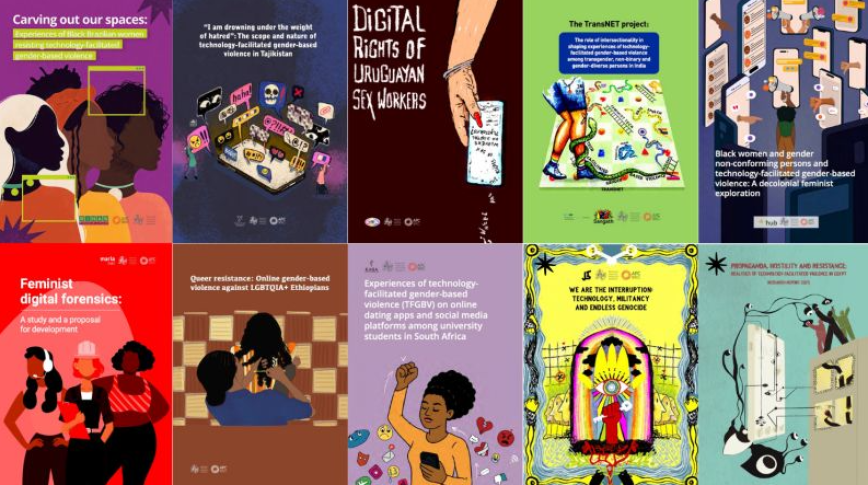
Read all the reports here and see below for an overview of the topics and authors:
- Experiences of technology-facilitated gender-based violence (TFGBV) on online dating apps and social media platforms among university students in South Africa (by Aretha Asakitikpi, Alex Asakitikpi)
- “I am drowning under the weight of hatred”: The scope and nature of technology-facilitated gender-based violence in Tajikistan (by Gulbakhor Makhkamova Ph.D., Victoria Fletcher / Women’s Center “Gulrukhsor”)
- We are the interruption: Technology, militancy and endless genocide (by Ghiwa Sayegh, Sabiha Allouche / Kohl)
- Queer resistance: Online gender-based violence against LGBTQIA+ Ethiopians (by Martha Tadesse, S.A)
- Feminist digital forensics: A study and a proposal for development (by Carl Jancz, Dany Araújo / MariaLab)
- Black women and gender non-conforming persons and technology-facilitated gender-based violence: A decolonial feminist exploration (by The Hub for Decolonial Feminist Psychologies in Africa, University of Cape Town, Department of Psychology)
- The TransNET project: The role of intersectionality in shaping experiences of technology-facilitated gender-based violence among transgender, non-binary and gender-diverse persons in India (by Eesha Lavalekar, Sharin D’Souza, Joshua Mark George / Sangath)
- Digital rights of Uruguayan sex workers (by Analía Lavin, Karina Núñez)
- Propaganda, hostility and resistance: Realities of technology-facilitated violence in Egypt (by Aya El-Husseini)
- Carving out our spaces: Experiences of Black Brazilian women resisting technology-facilitated gender-based violence (by Bárbara Paes, Ester Borges / Minas Programam)
FIRN is a collaborative and multidisciplinary research project led by the Association for Progressive Communications (APC), funded by the International Development Research Centre (IDRC) and APC. It focuses on the making of a feminist internet as critical to bring about transformation in gendered structures of power that exist online and onground. Members of the network undertake data-driven research that provides substantial evidence to drive change in policy and law and in discourse around internet rights. The broader objective is to ensure that the needs of women and gender-diverse and queer people are taken into account in internet policy discussions and decision making.
Find out more about FIRN: https://firn.genderit.org/