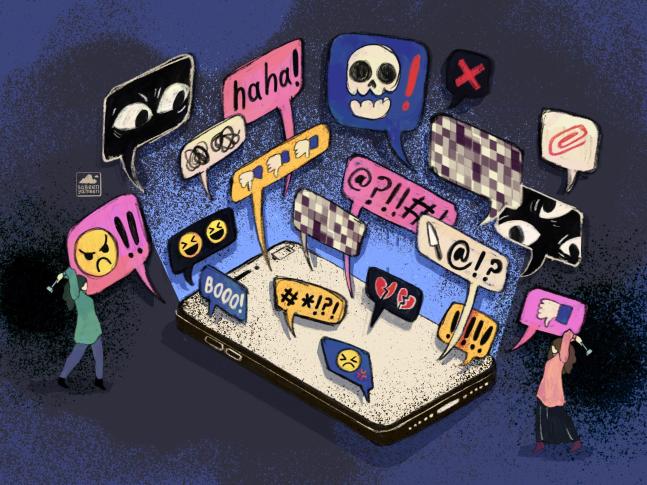
Illustration by Sabeen Yameen


Technology-facilitated gender-based violence (TFGBV) is an expanding and developing form of violence against women. The scale of TFGBV in Tajikistan is expected to grow as more women gain access to digital forms of communication and expression. TFGBV does not exist in a vacuum and the research explores if and how TFGBV differs from offline violence, the interconnections between the two and how societal and family norms relate to both types of violence against women. The ability of TFGBV to control an overall narrative on gender norms and the behaviour of women is explored. We consider if digital spaces give moral crusaders power to both monitor and control women’s online presence and to give large-scale visibility to women’s offline lives through social media posts. We show how these publications can allow for intimidation, threats and violence with the aim of forcing women to conform to a stereotypical image of who and what
a woman from Tajikistan should be. The research further investigates whether teenagers and children are similarly at risk and the extent to which this affects other aspects of their life. Other areas of intersectionality such as disability, ethnicity and location are also considered. This research involved semi- structured interviews with 59 women, focus group discussions with 55 women and an analysis of 182 cases of TFGBV that were identified. It assessed 22 social media posts and 3,885 comments on those posts. Findings show that women
are retreating from online life, self-censoring and not discussing sensitive topics around women’s rights. As a result of TFGBV, women have been driven to suicide, they have experienced physical violence, severe mental health issues and fear, have not been able to leave the house, have faced divorce and lost custody of their children, have suffered loss of property and employment, and have had to leave the country. As one woman explained, “These are not just words on a screen. These are real feelings, real pain and suffering.”
This work forms part of the third edition of the Feminist Internet Research Network (FIRN) project, supported by the APC Women’s Rights Programme and the International Development Research Centre (IDRC).