

Communities around the world are taking connectivity into their own hands, driving locally-led initiatives that are inclusive, sustainable and deeply meaningful to the people they serve. Yet where persistent gaps continue to hold them back, how do we best strategise the path towards their digital inclusion, addressing policy, capacity building and financial tools that are meaningful, adequate and accessible for them?
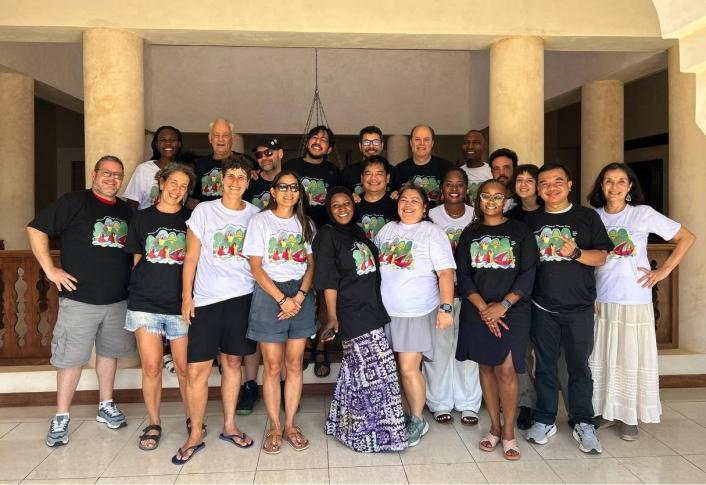
Guided by a strong conviction that these initiatives are a solution for bridging connectivity gaps, the LocNet initiative team came together in person in Kilifi, Kenya, to look back, evaluate progress made and map possible steps forward. Sheltered by the baobabs and acacias of this land, the team had the honour of visiting the Dunia Moja community network, learning directly from its experience, the realities the community faces, the challenges they've overcome, and the road still ahead. While in Kenya, we are also accompanying the bootcamp marking the close of the first African edition of the training programme for community network managers in Indigenous and rural communities, held in Nairobi.
With renewed energy and a clear sense of purpose, the year ahead will be one of focused, grounded work, advancing digital inclusion at the local and regional level while remaining firmly committed to gender inclusion, environmental care and the long-term sustainability of local communities in their path to connectivity.
Welcome to the 89th monthly round-up of developments impacting your local access networks and community-based initiatives.
Routing for Communities podcast
We are renewing the invitation to enjoy the two seasons of our Routing for Communities podcast. With our focus on Kenya these days, we recommend the second episode of season 1, where you will discover the experience of a community network settled in Kibera, the largest popular marginalised area of Africa.
Learn from this initiative, which these days is also hosting the bootcamp of the training programme for community network managers across the Africa region. Find it here and celebrate the vibrancy of Kibera residents in the initiative.
Find also all the episodes of seasons 1 and 2 here, also available on Apple Podcasts, YouTube and Spotify.
Tune in!
Community networks news and stories
- In Colombia, Colnodo celebrates the inauguration of the "Frailejones: Connection of Life", a community network in the village of Tasmag, within the Gran Cumbal de Los Pastos Indigenous Reserve. This is the second community network within the framework of the Connecting the Unconnected project supported by the European Union in Colombia, also in partnership with the Ministry of Information and Communication Technologies, the Internet Society (ISOC) and CITEL, the Inter-American Telecommunication Commission. Read more. [Available in Spanish]
- As part of the Mtandao Hewani project, Kijiji Yeetu Africa Network from Kenya convened a Knowledge and Mentorship Session for local leaders and opinion shapers to co‑design strategies for integrating IoT sensors with localised public WiFi infrastructure. This will enable farmers, households and citizens to access real‑time data on rainfall, soil moisture and air quality, vital in a region where floods and environmental degradation reduce agricultural yields by up to 20% annually. Read more.
- A multistakeholder conversation was held in Indonesia in the presentation of the national strategy for community-centred connectivity to the Ministry of Communication.The debate stressed that digital inclusion should not be measured only by expanded access and infrastructure, but by a rights-based approach ensuring accessible public digital services and meaningful participation of vulnerable groups, including persons with disabilities, Indigenous communities and disaster-affected populations. Read more. [Available in Bahasa Indonesia.
- In June 2025, devastating storms in South Africa’s Eastern Cape destroyed Zenzeleni Community Networks’s main communications tower in Nomadolo, cutting off internet access for more than 1,800 people and disrupting essential services, from online learning to healthcare access at Zithulele hospital, community hubs, support operations and everyday communication for families and elderly residents. Through emergency funding and support from 48percent, the tower was rebuilt with strengthened, storm-resilient infrastructure. Read more.
- “This training was not just about learning new skills; it was about understanding our communities’ identities and how technology can be a tool to enhance and preserve them.” This is one of the reflections included in the impact study of the 2024 ICT Network Management Bootcamp held in Guatemala, convened by the International Telecommunication Union (ITU) and the Association for Progressive Communications (APC). Read more.
- The community media collective Canto de Cenzontles devoted an episode of its weekly programme to amplifying initiatives that advance Indigenous communities’ right to communicate through the appropriation, management and development of their own technologies. TIC A.C’s Indigenous social-use concession, the community network Sueños del Manjar, alongside others are concreting technological autonomy in their territories, with women playing a vital role. Listen to the programme on their site, on Spotify or on YouTube. [Available in Spanish]
Gendered experiences
- What does it mean to think about infrastructures from a feminist standpoint? The article “Weaving networks of care and creativity” reflects on what a feminist mesh network is, sharing the learnings developed during the last Feminist Tech Exchange (FTX). Rather than focusing on routers, protocols or frequencies, these networks are centred on people, relationships, bodies, emotions and the invisible systems that hold us together. Read more.
- Research ICT Africa launched the Nigeria report of the After Access qualitative study on gender and digital technologies. The report, already developed in Ghana, Uganda and Ethiopia, examines the lived realities of female adolescents, medical workers, teachers and entrepreneurs’ digital adoption to determine the opportunities and barriers to digital inclusion in each country. Read more.
Enabling policy and regulation
- The Global UK Digital Access Programme (DAP) Peer Learning Event held in Nairobi brought together policymakers, regulators and organisations committed to digital inclusion. Organised by APC member KICTANet, the event was focused on sharing experiences and best practices on sustainable last-mile internet connectivity models, with discussions centred on expanding digital access to underserved and remote communities in Kenya. Read more.
- The Encontro de Conectividade Centrada em Comunidades held in São Paulo in October 2024 did an update of the self-affirmation letter from the Brazilian National Committee of Community Networks, originally signed in 2022. The document reaffirms the commitment to the collective struggle for the expansion and strengthening of community networks guided by the autonomy and freedom of the people. [Available in Portuguese and now also in English]
Publications, research and toolkits
- As India accelerates its push toward digital-first governance and services, millions remain offline. Locally run networks show how connectivity can be built where markets fall short, demonstrating that this gap is no longer just a question of access: it is a question of infrastructure. The article “Community Networks: Critical Infrastructure For Rural Connectivity In India” by Ritu Srivastava reflects on how community networks offer a practical, people-centered model for closing that gap. Read more.
- In a context of concentrated technological power and growing dependence on large platforms, how organisations manage their digital infrastructure directly affects data protection, autonomy and community security. In this scenario, a new report by Derechos Digitales asks: how realistic is it for organisations to develop their own or self-managed infrastructure given their technical and organisational limitations? Read more. [Available in Spanish]
- Despite major progress in Brazil’s digital infrastructure, many people still lack access to quality internet and essential devices. “Meaningful connectivity: Mapping affordability policies for Brazil” is an ITU publication supported by the FCDO, which uses new national indicators to identify public policies to address the affordability of fixed broadband and household computers. Read more.
- “A People’s Guide to Artificial Intelligence” is a publication that examines how AI shapes our present and its potential to build more equitable futures. Mimi Onuoha and Diana Nucera (Mother Cyborg) ask who is creating the future and how to ensure these creators reflect diverse communities and social realities. The book invites technologists and communities to rethink AI as a tool for liberation through popular education, design and storytelling. Read more.
Events
- From 13 to 16 April the first edition of the South Africa School of Digital Policy (community networks edition) (ZASDIP) will be held in Johannesburg. Read more.
- The 2026 Kenya School of Internet Governance (KeSIG) will be held online from 22 April to 15 May. The deadline to apply is 10 April. Read more.
- Organised by Access Now, this year's edition of RightsCon is going to take place in Lusaka, Zambia, from 5 to 8 May 2026. As a hybrid event it will allow in-person and online participation. Read more.
- This year edition of Digital Rights Asia-Pacific (DRAPAC) Assembly will be held in Manila from 8 to 10 June. Read more.
- The 2026 Global Gathering is open for applications. It will take place from 4 to 6 September in Estoril, Portugal. Read more.
Funding opportunities
- The twelfth call of NGI Zero Commons Fund is open. Its goal is to help deliver, mature and scale new internet commons, from libre silicon to middleware, from P2P infrastructure to convenient end-user applications. The deadline of this cycle is 1 April 2026. The guidelines for applicants provide the information to submit a proposal. Read more.
- Team CommUNITY relaunched the Equity Fund, an initiative that provides one-to-one travel, lodging, security and visa assistance for individuals from at-risk communities or operating in low-resourced environments who would not be able to attend the Global Gathering. Read more.
Community networks learning repository
Have you visited the learning repository? If not, we invite you to explore this collective online space for storing and exchanging resources useful in training processes, with a focus on materials made for and by community networks.
The platform also features the experiences of the National Schools of Community Networks in countries of all regions. Visit this section and learn more about these initiatives.
You are also invited to share resources that you or your organisation have developed. We encourage you to upload them to the learning repository and help us expand this space. Contributions in all languages are welcome.
This newsletter is part of the Local Networks initiative (LocNet), a collective effort led by APC and Rhizomatica in partnership with grassroots communities and support organisations in Africa, Asia and Latin America and the Caribbean. It aims to directly support meaningful community-centred connectivity initiatives, while contributing to an enabling ecosystem for their emergence and growth.
Previous editions of this newsletter are available here.
Invite others to subscribe to this monthly newsletter here!
One more thing! If you have comments about the newsletter or information relevant to the topic that you would like us to include in the next edition, please share it with us here.