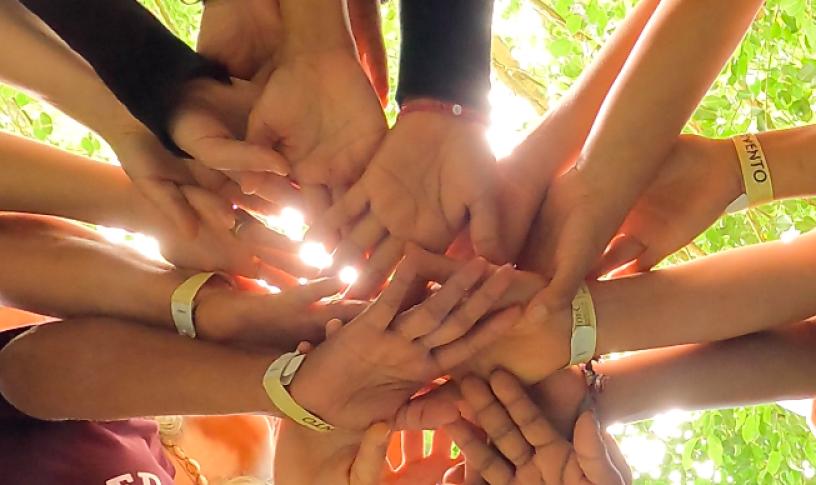
Image: Frame from a women's circle video


When we gathered in Nairobi for the Feminist Tech Exchange (FTX) in October 2025, the room felt electric, alive with curiosity, laughter and radical imagination. We came together to facilitate a session titled “Feminist Mesh Networks of Care and Creativity”, a workshop born from our shared desire to explore how feminist values might shape not only what technologies we build, but how we experience and relate through them. From the beginning, we knew we wanted to move beyond technical language and into something more embodied, more relational. We wanted participants to feel the connection itself as infrastructure.
A feminist mesh network is a community-owned, decentralised communication network designed and run using feminist principles like equity, care, autonomy, consent, accessibility and collective power. Here, it revealed itself not just as a metaphor, but as a method.
Rather than focusing on routers, protocols or frequencies, we centred people, our relationships, our bodies, our emotions, and the invisible systems that hold us together. Through movement, music, drawing and collective reflection, we invited participants to imagine what it truly means to build networks rooted in care, autonomy and creativity instead of extraction or control. Together, we dreamed. In the process, we built a network not with cables, but with care. In this piece we share a bit more about the routes explored in this process and the collective insights we carry forward.
"Together, we dreamed. In the process, we built a network not with cables, but with care".
Building belonging across a session
At the heart of the session was a simple but powerful question: What kind of network do we want to belong to? This question lived on a shared Padlet wall, a digital canvas that slowly filled with colour, words and interwoven lines of thought. Each post became a node in our feminist mesh.
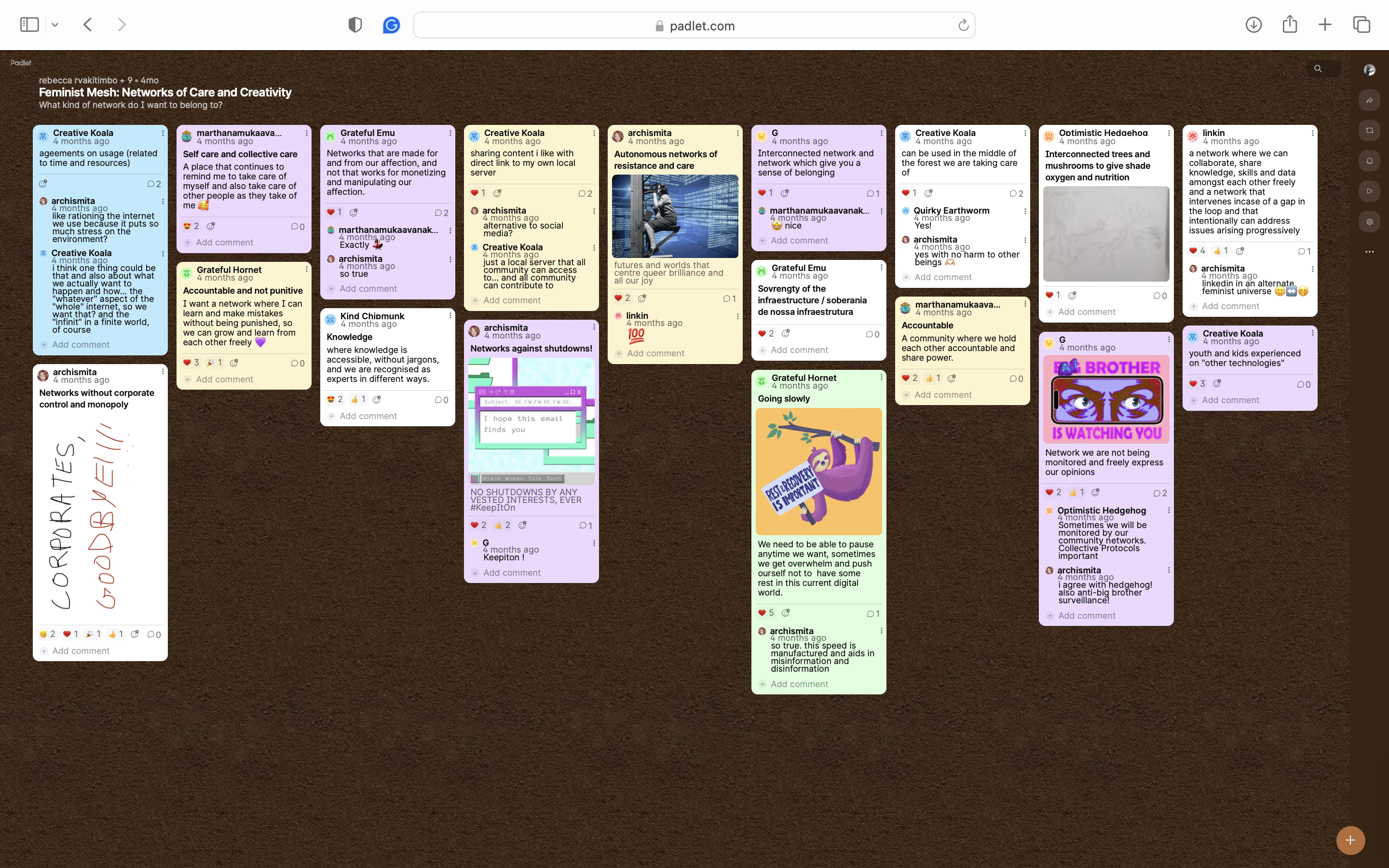
A Padlet digital canvas visualises the vibrancy of the feminist network developed during the FTX session.
Participants wrote of networks that listen, that grow slowly and intentionally, that are decentralised yet deeply human. They imagined technologies that reflect tenderness, joy and mutual respect. As these reflections accumulated, they began to form patterns that felt organic rather than random, echoing the ecosystems we are already part of: interconnected, adaptive and alive.
Across the Padlet, voices called for networks that hold joy, for connectivity practised as care, for systems that mirror our politics of love and justice. This reimagining moved us away from the cold language of efficiency and optimisation and toward something warmer and more humane, from infrastructures that extract to those that nurture.
By the end of the session, the Padlet had become a living archive, a collective map of dreams, anxieties, questions and intentions. Yet many participants felt called to move beyond reflection and into practice.
Weaving the nodes of our feminist mesh
The idea of the feminist mesh revealed itself not just as a metaphor, but as a method. We guided the group through an embodied exercise inspired by musical chairs, reimagined through a feminist lens. In this version, no one was eliminated. Instead, we moved together, adjusting our bodies, making room for one another, laughing as we negotiated shared space. Each shift mirrored the principles of feminist networks: constant adaptation, collective care, and a refusal of scarcity. No one was left out; everyone belonged.
As we reflected on this experience, it became clear how deeply these values translate into the digital realm. A feminist mesh is not only about building community Wi-Fi or local infrastructure. It is about rethinking how we connect, how we communicate, and how we show up for one another through technology. Again and again, participants returned to the idea that technology is not separate from our emotions, identities or bodies. The technique, we were reminded, is deeply personal.
As FTX Nairobi drew to a close, a group committed to forming a community of practice dedicated to exploring feminist connectivity more deeply. They spoke of building small-scale mesh networks in their own communities, creating training manuals and toolkits for feminist tech education, and partnering across regions to exchange knowledge and co-create infrastructures grounded in care.
"Our feminist future is not about faster connections, but deeper ones".
The energy in the room was unmistakable, a shared decision to begin building the worlds we imagine. The Feminist mesh workshop reminded us that technology can be a site of tenderness. Community Wi-Fi, local servers and offline archives are not just tools; they are stories, relationships and possibilities for justice. Our feminist future is not about faster connections, but deeper ones. It is about autonomy, sustainability and joy. It is about knowing that when we build networks of care, we are already building the future.
The Padlet remains open to a growing garden of ideas, sketches and feminist imagination. Join the mesh! View “Feminist Mesh: Networks of Care and Creativity” on Padlet
Rebecca Ryakitimbo is a feminist technologist and researcher working at the intersection of AI, gender justice and digital equity. She supports feminist tech spaces such as the African Women School of AI, and curates the Gendering AI conference. As part of the Local Networks (LocNet) initiative, she supports community-centred connectivity initiatives by facilitating communities of practice and researching community-centred connectivity and local services for equitable, locally led digital ecosystems.
Risper Arose is a community development expert with experience in grassroots community-responsive project design and implementation, digital inclusion, and movement and capacity building. She has worked with grassroots communities in underserved areas, focusing on building self-governed and owned communication infrastructure. She is the partnership lead for the Tanda Community Network, with the goal of fostering relationships for providing access to the knowledge, financing and tools as the resources required to help the community network demonstrate and scale social impact in the community. She is also the Africa capacity-building coordinator for LocNet at the African Advanced Level Telecommunications Institute (AFRALTI) and is a member of the Association of Community Networks in Kenya.