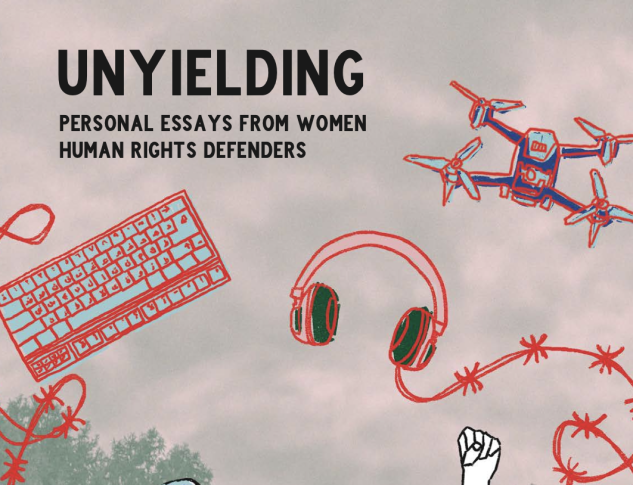
Illustration by Rawand Issa


Welcome, dear reader, to our Unyielding Anthology. I am deeply honoured to have worked with this inspiring group of feminist writers from across the world to curate this collection of personal narratives.
Over five months, between April and August 2025, the contributors to this anthology carefully crafted their stories, despite great challenges to their own well-being and safety. Some struggled with where to begin, others with where to land, and everyone grappled with the mental toll of recounting the harrowing violence. I do not take lightly the fact that everyone who undertook this journey with us is still alive today and still adamant in their conviction to keep fighting.
Across contexts and geographies, worsening inequalities have fuelled terrible violence, both online and offline, leaving women human rights defenders exposed to unprecedented abuse that is intimate, targeted, and deeply harmful to their personal and professional lives. From state and non-state brutality in the streets to orchestrated smear campaigns on media and digital platforms, this violence has evolved in ways that laws have failed (or refused) to address. In this context, it was essential to publish these first-hand accounts of resilience, strength and steadfastness, directly from those on the frontlines of defending queer and women’s rights, freedoms and dignity.
“I do not take lightly the fact that everyone who undertook this journey with us is still alive today and still adamant in their conviction to keep fighting.”
As an editor, I did very little besides check in on the authors and prompt them on how, exactly, they found the strength to carry on defending their rights and their communities in such overwhelming circumstances. Honestly, I was asking mostly for myself. I don’t know where to find strength anymore, amidst the unspeakable violence of the ongoing genocide in Gaza, as well as the ongoing Israeli war crimes against my home country. We are all living through a moment of great reckoning, especially with the digital tools we built to empower our movements now algorithmically assaulting us every day. Undoubtedly, our shared feminist dream to remake the world (and the internet) into a safer, freer place for us all now feels more defeated, more heavily burdened with what we have witnessed in our homes, in our collectives, and in our newsfeeds.
You will probably feel, like me, a consensus among the different lived realities of these narratives that the backlash against feminist activism – online and offline – has gotten terribly worse. And that both new and exacerbated challenges will not relent in the foreseeable future. We are, indeed, living through a historical time of the empire’s consolidation: rogue technological experiments, relentless war machines, and climate collapse. And yet we, in the resistance, have so much in common across geographies and cultures: the similarities are striking, as are the connections. Against all the odds, we reaffirm the special power of feminist storytelling in the face of silencing, co-optation and complicity. And though much has changed in our movement over the years, this mantra remains true: that when we tell our stories, we build bridges of connection, care and solidarity. In times of hopelessness, we reaffirm our faith in each other.
You will also notice a defiance in the authors’ linguistic choices, writing in what can be described as Postcolonial English, animated with the grammar and vocabulary of their mother tongues. I made a conscious effort not to tame any of these forms of expressions, neither with capitalisation nor punctuation nor fragmentation. If the sentence wants to run, then run it will. And if a local word appears without a footnote, I left it without footnote, trusting that you, our readers, are also like us, and that you will allow the unfamiliar to reveal itself to you in any way it chooses.
We have organised the contributions into five chapters: Brave Beginnings, The Digital Frontier, Identities and Intersections, Colonialism, States and Exile, and Imaginaries – though most of the stories weave across these headings. I would like to thank the team at APC for their kindness and support through- out this project and all the authors for their patience and generosity. I invite you to read all of their stories and, perhaps, like me, you will find in these incredible testimonies a renewed faith in our collective power to overcome anything. And, like me, you’ll be really glad all these folks are on our team.