
Tres generaciones celebraron los 30 años de Nodo TAU


Three generations celebrated Nodo TAU’s 30 years
The civil society association Nodo TAU has been working for three decades to bring information and communications technologies (ICTs) to social organisations and popular sectors in the city of Rosario, Argentina. And it does so by weaving a fabric of connections with other organisations, always with its feet firmly planted on the ground, its hands on digital tools and its heart in furthering the inclusion of the most vulnerable groups.
This anniversary gave the three generations that built Nodo TAU and saw it grow an opportunity to come together. The celebration was held at the Rosario Press Union’s Pichincha Centre, a space that has also witnessed the history of Nodo TAU. The reflections shared at this event evidence the many experiences accumulated over the years and the dreams for the future that strengthen an organisation that has always given its all, even in the most difficult contexts.
First steps: Technologies and social struggles
It was the year 1995 and a group of professionals from the fields of engineering, computer science and education came together with a vision to contribute to the struggles waged by Rosario’s organised social fabric by providing a resource that at the time was still very new: digital technologies and internet access. Through its social activism in grassroots communities in working class neighbourhoods, this group supported organisations working to advance human rights, memory and justice, women’s struggles, the protection of the environment, children’s rights, access to work and culture, and education, health and housing issues, among other causes.
In addition to giving them access to technology, the group incorporated advocacy efforts aimed at guaranteeing that such access be considered a right. Since its inception, the initiative has been underpinned by two convictions: that the lack of access to information and communications technologies exacerbates other processes of exclusion and that access to these technologies is a resource that contributes to the achievement of the goals of the organisations. The connection with international organisations also helped bring them digital technologies. Moreover, it had a positive impact on Nodo TAU, because it was during those initial years that the organisation joined the Association for Progressive Communications (APC).
“I highlight the human group that came through the organisation over the course of all these years, continuing this way of being, of fellowship and of envisioning a better world. Nodo TAU was born to offer communication for all, for people who now have a mobile phone but who at that time did not. That was the beginning. But the goal was, and is today, to build a better world. That is still very much a part of it and it will continue to be.” Damián Vazquez, founding member of Nodo TAU.
Spaces that marked moments in its history
Nodo TAU’s history can also be explored through the spaces it inhabited. From this small office in the company of one of its founding members, the organisation developed its first projects: the community server to host the email accounts and websites for the organisations; a computer bank that received donations of equipment to be repaired for use in community spaces; and the enREDando programme, a milestone that still structures Nodo TAU’s three main areas of work. These areas are access to technology in the Community Telecentres network operated by the organisations themselves, training in the use of digital tools, and communication of Nodo TAU’s activities through the Boletín enREDando newsletter..
“A computer in the neighbourhood, incorporated into people’s daily lives, so we could schedule an appointment in Anses [the social security agency] – that was something totally new. It was also used as a tool to transform the realities of vulnerable sectors. Nodo TAU brought us access to technology, allowing us to connect, to build something new, fostering solidarity and equal opportunities in a world that was becoming digitalised.” Emma Fernández Peña, instructor in the Qom neighbourhood of Indigenous communities.
As the organisation grew, the momentum allowed Nodo TAU to pursue another of its dream projects: sharing the house with others and turning it into a space to gather and coordinate. And they achieved it: for years they shared a house with the Community Radio Forum of Argentina (FARCO), the Gender and Development Institute (Insgenar), the La Masa Cooperative and the Angelelli Bishop Group (GOA). New challenges were taken on there, such as the establishment of the Free Telecentre, with funding from UNESCO and operated with free software.
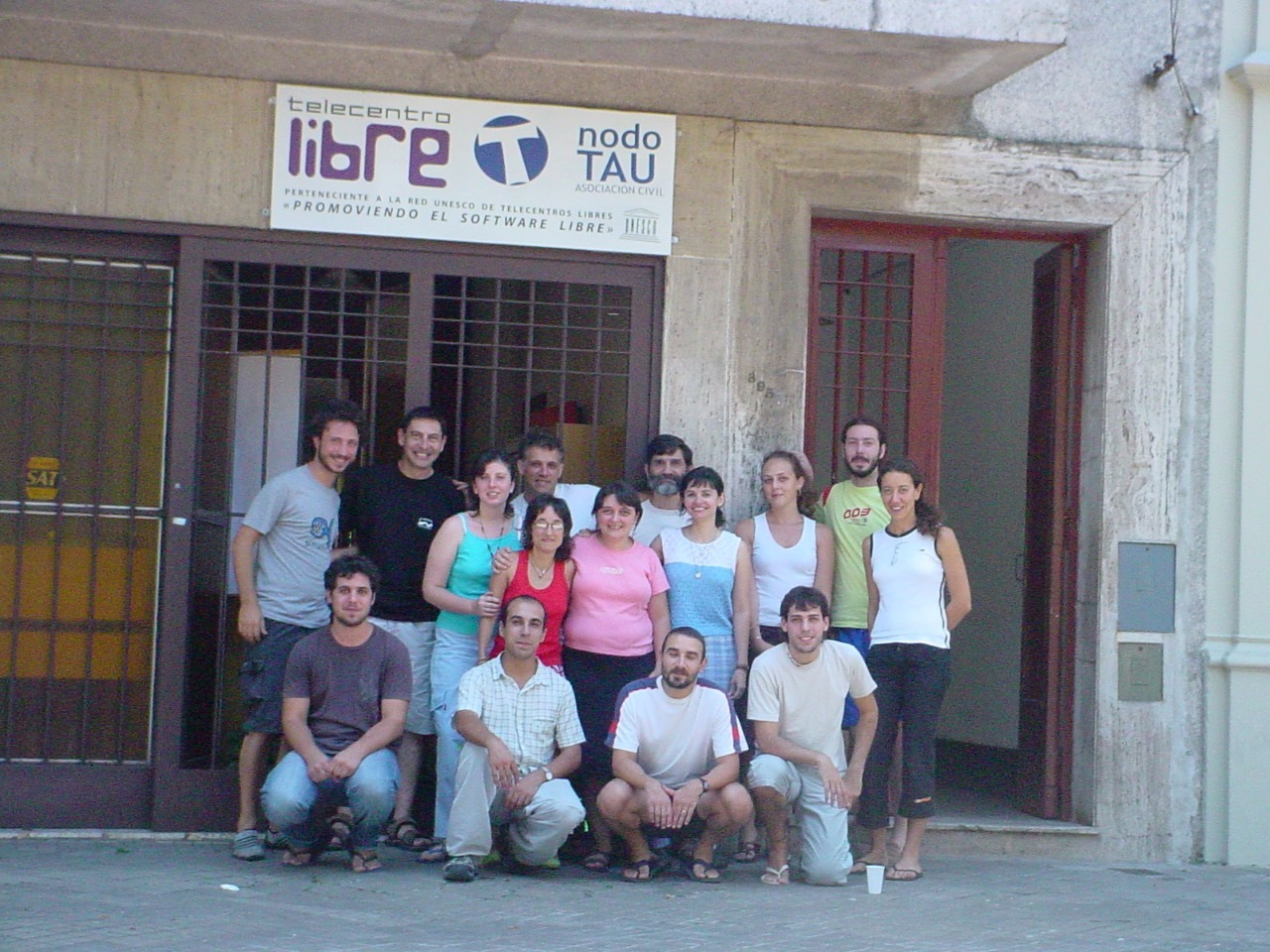
The house shared with other organisations and serving as headquarters for the Free Telecentre.
“Nodo TAU was a pioneer in bringing information and communications technologies to social organisations. It was established when the internet was still inaccessible. It gave people and organisations the possibility of having access and it also provided training so that they could use those technologies. The Free Telecentre offered training in these tools for social organisations and the people from the neighbourhood.” María Victoria Escobar, Free Telecentre coordinator.
From lack of access to excess: Environmental issues and labour inclusion
It was also in that shared house that Nodo TAU began experiencing another aspect of these technologies. The equipment donated started piling up and many computers were beyond salvaging. This opened up a new field, which came with new social and environmental issues, as well as new challenges, such as training in computer repair and waste management to deal with the unsalvageable equipment. These were the first steps towards the Electronic Waste Management Plant. From a lack of access to technology to excess discarded computers, Nodo TAU, along with other social actors, found another inclusion-fostering project there.
“It is a tool that allowed us to change the lives of many people. The recycling plant offered a new horizon for many young people, allowing them to envision a future for themselves and from that place build a family and achieve something beautiful. The plant is a child borne by Nodo TAU.” Joel Arnold, Electronic Waste Management Plant and TAU Cooperative contributor.

Young people from the TAU Cooperative that now runs the Electronic Waste Management Plant.
The Plant is now a reality, made possible through the determination of those who took on this project, convinced of its potential. Today it is managed by a cooperative formed by young people from working class neighbourhoods who took their first steps there in a labour market that offered them few opportunities for insertion and growth. With support from the New Opportunity Programme for social and labour inclusion of young people, the Plant was strengthened through coordination with the national Environmental Agency, the International Labour Organization, local public and private universities and organisations from other countries, such as Pangea, an APC member from Spain, among other institutions and companies.
“Nodo TAU was a huge door that opened up for us. I learned much more from the people there than from my university studies. These people teach you and they don’t keep anything to themselves. That is greatly appreciated, as is the daily support they give you. They are always there for whatever we need.” Elías Rodríguez, TAU Cooperative president.
Popular education as a methodology and communication as a tool
As the Plant grew, Nodo TAU continued to focus on training and communication projects. These include the Digital Territories project, which provides neighbourhood training, Urdimbre digital, a project with groups of women formed during the pandemic, the Environment and ICTs Course jointly developed with Colnodo, an APC member from Colombia, and the ANERA project with AlterMundi, another APC member from Argentina, for strengthening the local movement of community networks. These projects are undertaken with a critical view of technology, towards enabling social appropriation by organisations and based on popular education as the methodology that favours these processes and strengthens those who engage in them.

Computer workshop in the Digital Communities Programme.
Today, Nodo TAU’s work is boosted by the Digital Communities Programme, which created more than 60 community access spaces and is still growing. Together with the Rosario Technological Hub and the New Opportunity Programme, Nodo TAU equips community spaces with computers refurbished at the Plant and it supports training activities for the organisations.
“Nodo TAU provides a community service. It makes sure that all the communities have their equipment, their computers, and it does so forging a bond with them. There is a platform where people can post messages saying their mouse broke, or their keyboard is not working, or they’re having problems with the computer. And somebody will take care of it. It’s not just about giving them a computer like charity. I had never seen something like this. I think it’s something unique in its kind.” Carolina Sosa, instructor of workshops on literacy, citizenship and digital security for social organisations.
Looking back at the past, strengthening the present and projecting the future
By recording its history and sharing what it does today, Nodo TAU also projects its future. The Plant is an initiative that is growing significantly and will soon move into a space double the size of its current premises, with new projects in sight and with urgent needs, aspirations and dreams.
It has been 30 years and contexts have changed, but the vision of those early days remains as part of that same mission: to include and transform. Today it is furthered by new people, who give continuity to a project that raises the banners of solidarity and inclusion, with the aim of achieving a world in which everyone can access the resources that will enable them to fully enjoy their rights.
“It is surprising and moving to see how many years have gone by and they are still relevant as an association. We see how they help communities, how they forge bonds, how they provide opportunities for so many people. I learn every day from the Cooperative and I learn from Nodo TAU.” Cristian Salazar, TAU Cooperative disassembling area.
“I celebrate that desire to transform reality that led us to launch this experience. I celebrate those who joined us along the way to make Nodo TAU grow and develop with creativity, rebelliousness and innovation. I celebrate APC for supporting us and opening their doors to us, giving us the opportunity to meet wonderful people spread out throughout the world but connected. And I celebrate – why not? – the naivety of believing that we could build a more democratic world using technology. I celebrate that Nodo TAU is celebrating today.” Danilo Lujambio, Nodo TAU founder.
Florencia Roveri has been with Nodo TAU since 2003. Throughout these years she has been responsible for the Boletín enREDando newsletter, participated in the drafting of Argentina country reports for Global Information Society Watch (GISWatch) publications, and contributed to the coordination of training workshops on digital rights and popular communications tools and to project development. She holds a bachelor’s degree in Social Communication from Universidad Nacional de Rosario and is currently the communications associate for APC’s Local Networks Programme on the APC communications team.