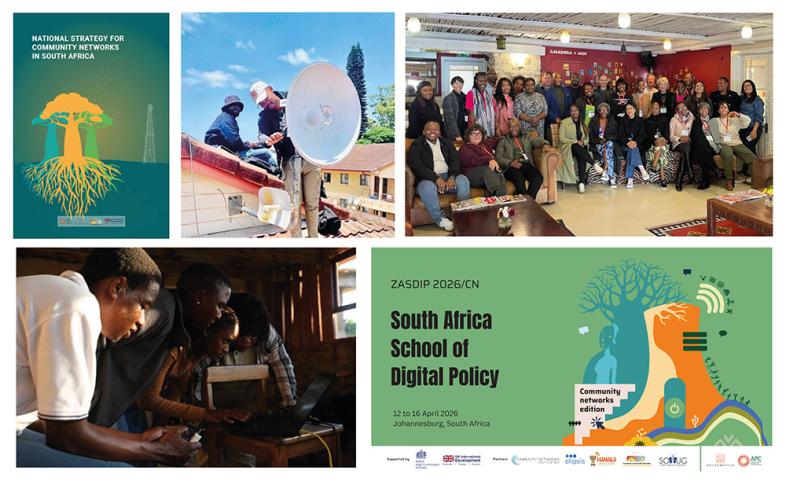


South Africa’s digital landscape is often described as paradoxical. While 98.8% of the population is covered by 4G infrastructure, around 21% – more than 13 million people – remain offline, primarily in rural, township and peri-urban areas. As informed by the National Strategy for Community Networks, only 1.7% of rural households are connected, compared to 13% in urban areas, and the cost of connectivity remains prohibitive for low-income communities. A household could be required to spend up to 38.4% of its monthly income to buy just one gigabyte of data.
In parallel, across eight of the country’s nine provinces, community-centred connectivity initiatives (CCCIs) are working to close these gaps – providing affordable, reliable internet to areas commercial providers overlook – thereby driving progress in education, healthcare and local economic development. But in doing so, they also have to deal with lack of opportunities to access key resources for their initiatives to thrive and grow.
These CCCIs face significant challenges in accessing not only connectivity itself, but also licences, spectrum and financial support. Access to these resources is governed by norms and policies that, until now, have largely been shaped without the meaningful participation of the communities they affect.
“Policy and regulation in the telecommunications sector [have] historically been designed with large commercial operators in mind, with the assumption that benefits will find their way to everyone else. But the reality on the ground tells a different story,” highlights Yumna Panday, from Zenzeleni Community Networks and the Local Networks (LocNet) initiative's national coordinator for South Africa.
Zenzeleni is an emblematic community network in South Africa, based in the OR Tambo District, in the east of the country. Their experience illustrates what is possible when policy meets people. When the Independent Communications Authority of South Africa (ICASA) introduced a licensing exception for community networks, a rural community was able to build and own its own telecommunications infrastructure – bringing affordable connectivity to villages that commercial operators had no intention of serving. “What that means in practice is affordable access, and the opportunities that come with it, for communities that had almost none. So, policy can change lives, but only when it is designed with the people at the centre, not as a footnote,” explains Yumna.
Supported by a new national strategy for community networks, these communities have an opportunity to make their voices heard in the spaces where these resources are regulated – spaces that have historically been difficult to access for marginalised groups.
A strategy in the road to action
The National Strategy for Community Networks is a three-year action plan (2025-2027) developed through a broad multistakeholder process. The document departs from a strong premise: “community networks offer a proven alternative” for a meaningful digital participation.
The strategy defines priorities around policy reform, sustainable funding, capacity building and social inclusion – and it is already being operationalised. Alongside launching the plan, the process also catalysed the creation of the Community Networks South Africa (CNSA) association, established to align efforts across the sector.
As Kathleen Diga, LocNet programme co-manager at the Association for Progressive Communications (APC), puts it: “Within the national strategy, there is a strong emphasis on an enabling policy and regulatory environment – and specifically that we ensure there is a voice of underserved and rural regions.” In the path to amplify those voices, Katheen also highlights the importance of guaranteeing that “those engaging with government have the confidence and mentorship to speak and write and interact in the provided public consultation processes and forums.”
Concrete opportunities ahead: the ECA Bill and spectrum regulation
Together with the contrasts in the country, South Africa presents an advanced and progressive policy environment for digital inclusion, including the National Development Plan, the ICT Policy White Paper, the Digital and Future Skills Strategy and SA Connect. However, significant gaps persist in how civil society organisations, community networks, small internet service providers and local governments engage in digital policy making.
The strategy’s emphasis on policy engagement is especially timely. Two significant processes are on the horizon, and both represent critical windows for community networks to shape the rules that govern their work.
The first is the anticipated Electronic Communications Amendment (ECA) Bill. This legislation has the potential to reshape how connectivity infrastructure is regulated in South Africa, including provisions that could affect licensing, access and the operating conditions for smaller and community-based operators. A version of the Bill has just been passed, and the public consultation processes around it will require that community networks and civil society to be present, informed and vocal.
The second is spectrum regulation. A precedent was the 2024 “Next Generation” Radio Frequency Spectrum Policy that already includes language acknowledging community networks. Ongoing developments – including draft regulations on the management of the 3800-4200 MHz and 5925-6425 MHz bands – will determine who gets access to the airwaves and under what conditions.
“The connectivity future is bright in South Africa, as the timing is right with the current movement in policy, interest to look at community networks as social enterprises with a basis of sustainability and local economic development through the digital. We are not far off if stakeholders rally together in genuinely wanting to tackle digital inclusion in a systematic and intentional way for rural communities” explains Kathleen Diga, APC Locnet's co-manager.
The South Africa School of Digital Policy: building the capacity to engage
To engage meaningfully in these processes, communities need more than goodwill – they need skills, tools and confidence. That is precisely the aim of the South Africa School of Digital Policy – Community Networks Edition (ZASDIP 2026/CN), being held from 12 to 16 April 2026 in Johannesburg.
Strengthening community-centred connectivity requires more than infrastructure; it depends on skills, knowledge and local capacity. Attending these needs, communities are not only building technical expertise, but are also developing participatory, bottom-up learning approaches tailored to their realities.
Led by CNSA, with participation from Ellipsis Regulatory Solution, Mamaila Community Network, Soweto Wireless User Group (SOWUG) and Zenzeleni, ZASDIP 2026/CN is convened by LocNet – jointly driven by APC and Rhizomatica – with support from the British High Commission in Pretoria and the UK Government’s Digital Access Programme. It will count with the participation of the country's Minister of Communications and Digital Technologies Solly Malatsi.
“The curriculum and certification options available in South Africa were designed for commercial operators and do not reflect the realities of what community network practitioners actually do,” reflects Yumna. “That is precisely why the School of Community Networks curriculum standardisation work matters. For the first time, there is a deliberate effort to develop and accredit a curriculum that speaks to community networks specific skills and realities,” she points out.
In terms of policy, the challenge is how to involve all these knowledge, experiences and needs in the advocacy process. “Community networks practitioners know their work deeply. What is harder to build is the ability to translate that knowledge into the language of policy, of investment, of advocacy,” says Panday, sharing her vision from the experience of Zenzeleni and CCCIs. “That gap keeps community voices out of the spaces where decisions that affect them are made, and closing it is one of the more difficult and underestimated dimensions of capacity building in this sector."
The forthcoming ZASDIP edition proposes to combine theoretical learning with hands-on practice, covering internet infrastructure, policy and regulation, digital economics and human rights governance. Inspired by the African School of Internet Governance (AFRISIG), it is designed to connect policy knowledge with lived community experience – and to equip participants with the analytical tools and advocacy skills to engage in the forthcoming public consultations, including on the ECA Bill.
“The School hopes to build some interest and excitement around policy,” says Kathleen. “We hope to make it informative but also engaging – and that the training brings forward strong fellowship and collective purpose. With strong commitment and mentorship, we see rural voices amplified in these processes.”
And Yumna notes: “For too long, the conversations that shape telecommunications policy and infrastructure investment have happened without community networks in the room. Policy that is made without their representatives present will continue to serve everyone but them.” And this is the reality these initiatives are aiming to change.