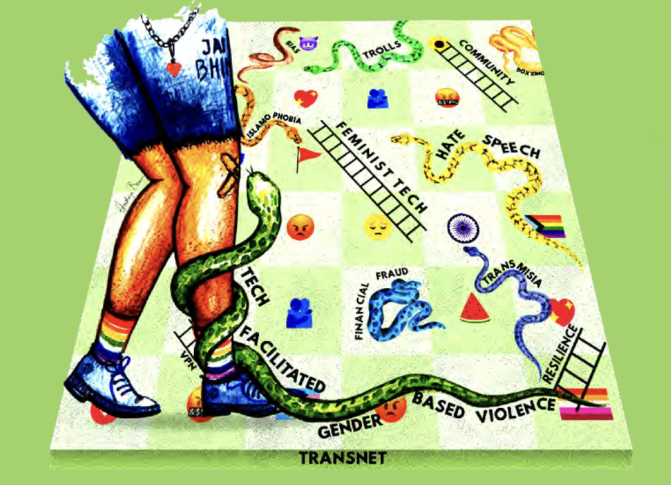
Illustration by Aindriya Barua


Over the past decade the world has witnessed large shifts in the evolution of the internet and its integration into the daily lives of the vast majority of society. This expansion of digital technologies and internet access in India has had significant implications for individuals from gender and sexual minorities including transgender, non-binary and gender-diverse communities. It has been widely seen that while digital spaces can offer important avenues for identity expression, community building and activism, they are also increasingly sites of exclusion, harm and violence.
Gender-based violence (GBV) is an umbrella term for a range of harms perpetrated against a person, which stems from power inequities based on gender roles. Moreover, for gender and sexual minorities, instances of GBV are not isolated incidents but part of a broader continuum of structural violence shaped by systems of patriarchy, casteism, ableism, communalism and heteronormativity. Emerging research shows that while women and girls are disproportionately impacted by GBV, TNBGD persons and men who fall outside of the dominant normativity of masculinity in a culture are also harmed by GBV.
These offline hierarchies of gender and identity-based violence are often extended, adapted or morphed to the digital landscape, resulting in technology- facilitated gender-based violence. TFGBV refers to any act that is committed, assisted, aggravated or amplified by the use of information communication technologies or other digital tools, that results in or is likely to result in physical, sexual, psychological, social, political or economic harm, or other infringements of rights and freedoms. TFGBV can manifest in the form of cyberstalking (following someone on online platforms without their consent or knowledge), trolling (rude or mean comments to provoke), doxxing (sharing another person’s private information in a public forum), online harassment (repeated online abuse), non-consensual image sharing (posting private images of someone else without permission), deepfake pornography (fake sexual content using someone else’s face), gendered disinformation campaigns (false stories targeting someone’s gender), and so on.
Although TFGBV manifests at an interpersonal level, it is rooted in discriminatory structures that reinforce sexist gender norms. Women and LGBTQIA+ communities experience TFGBV disproportionately, with recent studies based in India showing that TNBGD people reported the highest proportion of incidents of technology-facilitated violence experienced, followed by cis women and then cis men.4 Moreover, when GBV moves from offline to online spaces, it can become even worse because digital platforms easily cross physical and geographical boundaries.
This work forms part of the third edition of the Feminist Internet Research Network (FIRN) project, supported by the APC Women’s Rights Programme and the International Development Research Centre (IDRC).