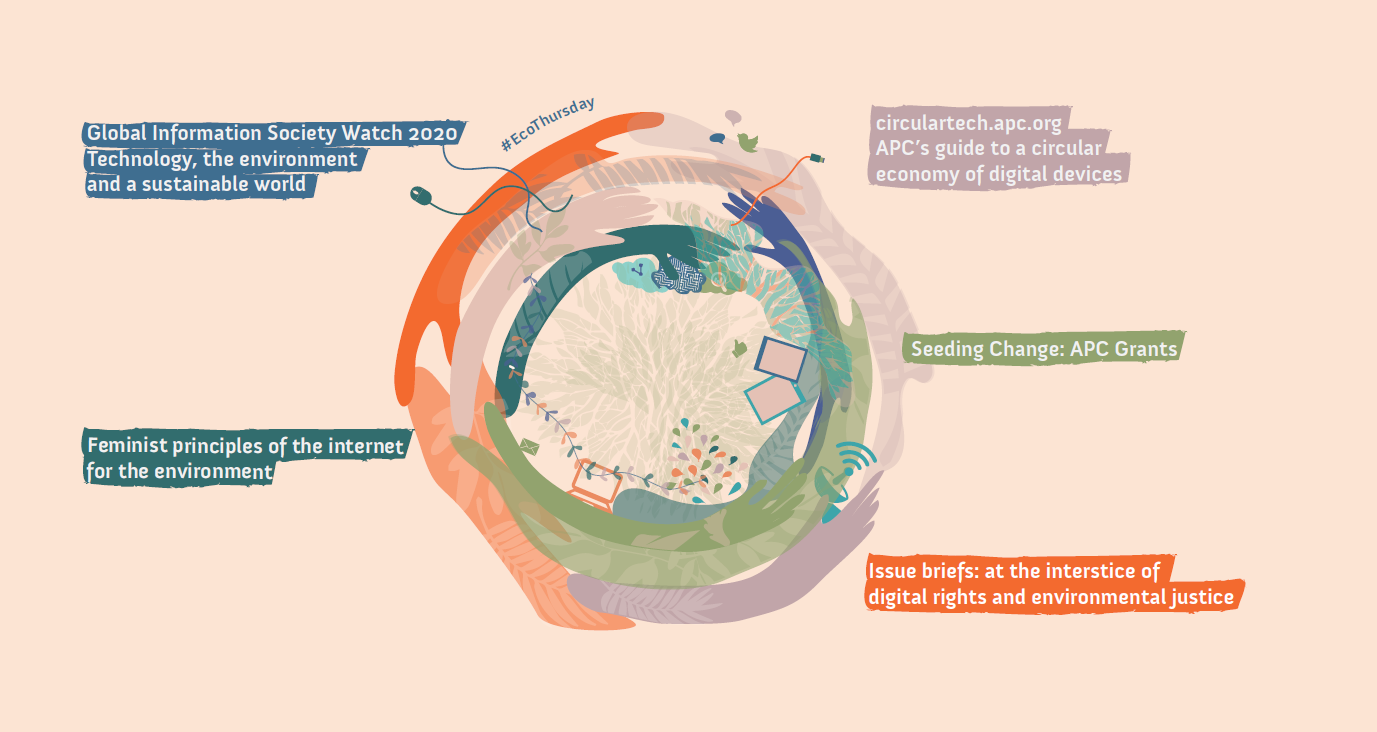
APC is committed to contributing to environmental justice and preservation of the Earth and mitigating the negative environmental impacts of the internet, digital technologies and the digital economy through our collective actions and activism. APC's history is rooted in the green movements, which still nurture our decades-long experience with a hands-on approach to technology and its use in ways that are sustainable and promote social and environmental justice and human rights.
At the interstice of digital rights and environmental justice: Four issue briefs to inform funding
In October 2021, APC joined a new research project supported by the Mozilla Foundation, Ford Foundation and Ariadne to explore how digital rights and climate and environmental justice intersect. The research is grounded by a landscape review developed by the The Engine Room, At the confluence of digital rights and climate & environmental justice, which identifies current barriers to and opportunities for greater collaboration, and highlights recommendations for funders to provide support. More than anything, the report concluded that “what seems necessary and possible to foster is a productive interface between movements/communities and grant makers, which acknowledges the hard work being done already by communities and which supports them to carry out their work in a structural and sustainable (in many senses of the word) way.”
The four issue briefs developed by APC are the result of collaboration among a small working group of APC members, partners and staff. Lead writers for each brief worked closely with members of the APC network to reflect diverse experiences and knowledge of digital rights and climate and environmental justice. Each brief states the key problem from the perspective of the APC network, suggests mechanisms or processes for engagement and actors we feel are worth engaging, and includes specific recommendations for donors. These briefs explore emerging issues and propose pathways for future work:
- Mapping the gaps between digital rights and environmental justice actors in the global South
- Environmental and digital rights: Exploring the potential for interplay and mutual reinforcement for better governance
- Extractivism, mining and technology in the global South: Towards a common agenda for action
- Addressing the impact of disinformation on environmental movements through collaboration
Global Information Society Watch 2020 - Technology, the environment and a sustainable world: Responses from the global South
This edition of Global Information Society Watch (GISWatch) seeks to understand the constructive role that technology can play in confronting the climate crises. It disrupts the normative understanding of technology being an easy panacea to the planet’s environmental challenges and suggests that a nuanced and contextual use of technology is necessary for real sustainability to be achieved.
A series of thematic reports frame different aspects of the relationship between digital technology and environmental sustainability from a human rights and social justice perspective, while 46 country and regional reports explore the diverse frontiers where technology meets the needs of both the environment and communities, and where technology itself becomes a challenge to a sustainable future.
A guide to the circular economy of digital devices
This guide aims to show you how to understand, think and act collectively to clearly change direction towards a regenerative and redistributive economy respecting both human and ecological rights and limits. It is aimed at civil society organisations wanting to transform their day-to-day use of technology, social entrepreneurs who want to make a positive impact on the world and the environment we live in, or anyone else interested in connecting, whether online or offline, in a more sustainable way.
This resource focuses on the digital devices that we use and touch – desktop computers, laptops, mobile phones and tablets. Available in English, Spanish and French, it is divided into 12 modules, and illustrated through case studies. It describes the concepts, processes and some of the major challenges to circularity, summarises the key challenges and opportunities, including for policy advocacy, and offers a glossary of terms to help you along.
Towards a new feminist principle of the internet on the environment
The Feminist Principles of the Internet (FPIs) are a series of statements that offer a gender and sexual rights lens on critical internet-related rights. Currently there are 17 principles in total, available in 11 languages and organised in five clusters: access, movements, economy, expression and embodiment. Together, they aim to provide a framework for women's movements to articulate and explore issues related to technology. A thematic report written by Jes Ciacci of Sursiendo for the 2020 edition of Global Information Society Watch (GISWatch) captured the process and the draft FPI on the environment. This is an ongoing journey as APC, through the Technology, environmental justice and sustainability project and the APC Women’s Rights Programme, alongside digital rights, environmental and feminist allies, works towards finalising an FPI on the environment.
Here is the draft FPI on the environment:
A feminist internet respects life in all its forms; it does not consume it. Our proposal for a feminist internet principle in relation to the environment resignifies care towards an ethics of collective care in choices around design, extraction, production, consumption and disposal of the technologies involved.
If you want to read more, we invite you to check these two publications by APC partner and close ally Sursiendo, that are the result of the hackfeminist meeting “Technology and affections: How to outline policies of [co]responsibility” held in Chiapas, Mexico in July 2019.
Technoaffections investigates the politics of shared responsibility and speaks to our first relationships with technology through memory, feelings and emotions. Arising from the hackfeminist gathering, the 12 chapters unpack the politics of shared responsibility as creative and collaborative, rooted in experiences of land defence, feminism and social movements. How do we build ethical and fair practices to ensure that our use of technologies respects the environment?
Let us imagine contains hackfeminist writings for alternative technologies that look at relationships between ideas of love, work, alternative economies and memory that teach us about care to arrive at strategies that nurture our communities. This collection of 20 writings from participants are a rich and diverse collection of thoughts and creativity about the politics of shared responsibility for people and the Earth.
Seeding change: APC members and grants
The APC network is integrated by many members and associates who advocate locally and in some cases regionally on technology and environmental justice and sustainability, mostly in the global South. Some of them are Acción Ecológica in Ecuador, Arid Lands Information Network in Kenya, BlueLink Information Network in Bulgaria, Body & Data in Nepal, Bytesforall Bangladesh and VOICE in Bangladesh, Colnodo in Colombia, Digital Empowerment Foundation, Servelots and SPACE in India, EMPOWER in Malaysia, CITAD, Fantsuam Foundation and MAJI in Nigeria, Foundation for Media Alternatives in Philippines, Computer Aid International and GreenNet in the UK, Intervozes and Nupef in Brazil, May First Movement Technology in the US, Nodo TAU in Argentina, Open Culture Foundation in Taiwan, Pangea in Barcelona, PROTEGE QV in Cameroon, Rhizomatica in Mexico, Strawberrynet Foundation in Romania, Sulá Batsú in Costa Rica, and Zenzeleni Networks NPC in South Africa.
Channelling resources to our network members has been a priority for APC since its inception. We have done this in different ways, ranging from Global Information Society Watch (GISWatch) to Take Back the Tech! as well as member travel and exchange grants. In 2016, we launched additional grants with support from the Swedish International Development Cooperation Agency (Sida) aimed specifically at enabling members to contribute to achieving the impact objectives identified in APC’s strategic outcomes for 2020-2023.
Many highlights of the impact achieved locally by our members through subgranting have been captured in the stories that are part of a regular column, Seeding change. If you want to get started, we invite you to read these two stories that relate to environmental justice:
- Seeding change: Communities mobilise open data to challenge oil industry pollution in Nigeria
- Seeding change: Environmental sustainability and the need to strengthen female leadership
- Seeding change: Pangea on reducing our digital footprint
Join us every week on social media for #EcoThursday
Starting on 6 October, we invite everyone to join our members and partners every Thursday on APC's social media channels (Twitter, Facebook, and Instagram), where we will convene and connect academic and activist knowledge about how to use the internet and digital technologies to adapt to and combat climate change.
Building on our history of emerging from green movements and our ongoing connections with them, and the decades-long experience with a hands-on approach to technology and its use in ways that are sustainable and promote social and environmental justice and human rights, we will use our social media spaces to open discussions and engage relevant organisations in the field, while also highlighting how environmental justice intersects with other areas. It will be an inspirational and engaging convening space, an intersectional analysis catalyser and why not, a mobilisation device. And there's even more: on the last Thursday of every month, one of the APC members engaged in the tech and environmental sustainability field will be taking over the APC Twitter account, with its over 24,000 followers, to share information about their local work to advance environmental justice, introduce relevant materials, and inspire us with replicable cases and challenging questions.
Remember that you need to make sure to follow APC social media channels, and be there on Thursdays ready to engage in this convening space using #EcoThursday.
You can also join our Twitter list on tech and climate justice to stay informed!