
Photo: Dewang Gupta on Unsplash


Platform workers have consistently highlighted abysmal payouts, erratic rate cuts, tedious working hours, panoptic surveillance, and ineffective grievance redressal systems in India. Wages are determined algorithmically, fluctuating according to the variables companies choose to prioritise. With their income hinging on daily, weekly or monthly incentives, workers are inadvertently pressured to work long hours, target peak demand periods or travel to multiple locations to maximise their incomes. Led by the Internet Research Lab, India, “GigSaathi: A feminist action research project to address wage disparities and platform power”, aims at addressing a key power dynamic between digital platforms and gig workers: the information asymmetry on wages.
Implemented in partnership with the Rajdhani App Workers Union, a union of gig workers in Delhi National Capital Region associated with CITU (a central trade union organising workers since 1970), the project piloted an already-prototyped WhatsApp chatbot, GigSaathi, where workers from the ten-minute delivery platforms (i.e. Swiggy, Zepto and Blinkit) in India can self-report earnings, expenses, working hours, and other work-related concerns. The chatbot is accompanied by a dashboard with time-series data visualisations that demonstrate wage payouts and expenses, which can then be fed back to workers to allow them to gain better insight into their own wages.
The project was undertaken with the support of a #FeministTechJoy Grant, administered by APC's Women's Rights Programme (WRP) as part of its long-term commitment to support the activities of partners and allies working towards a feminist internet.
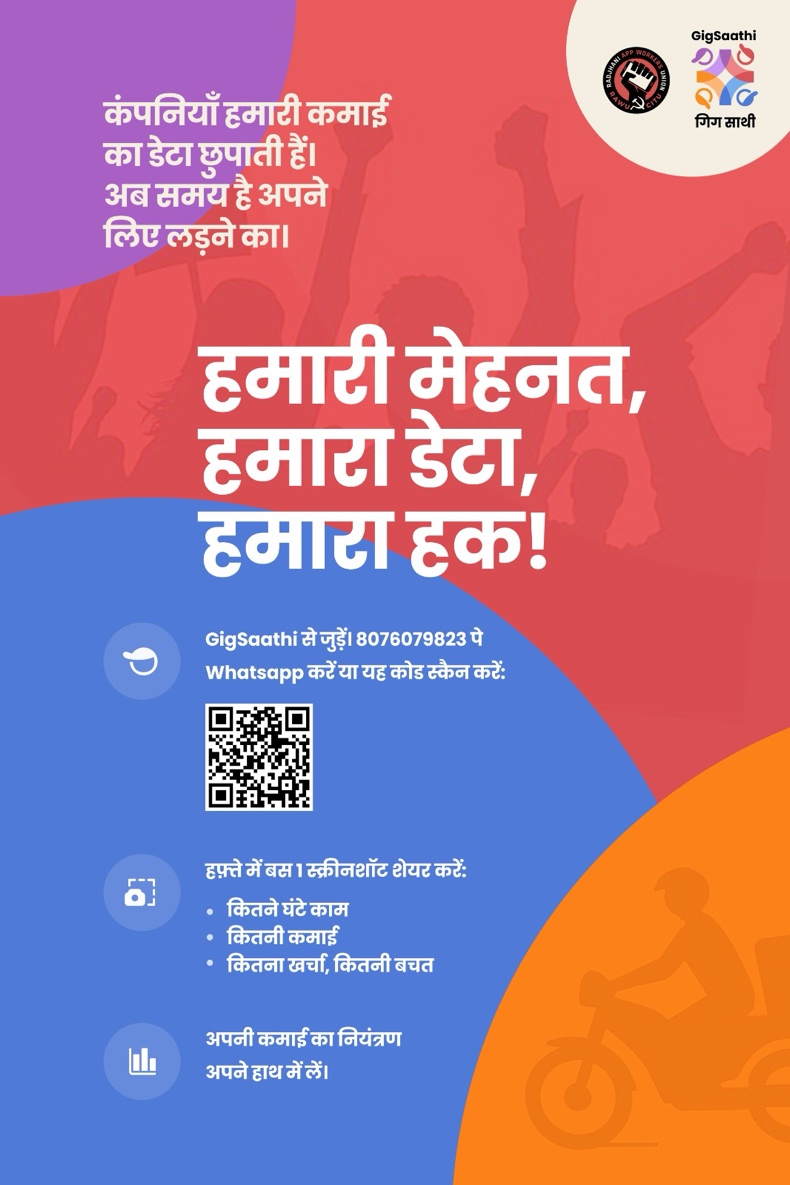
Throughout their engagement with the community, the team learned that workers go on strikes regularly whenever there is a shift in their earning structure. Yet, they remain trapped in a wage structure that has grown increasingly opaque, thereby intensifying their precarity through unstable income and continually changing payment terms driven by an inequitable incentive structure. One worker has shared that weekly rate cards that specified the wage floor per kilometre were there prior to the COVID-19 pandemic. These, however, were removed as platform economy rapidly expanded in the years that followed.
Against this backdrop, systematic data collected through workers and the subsequent analysis and shareback through GigSaathi, can help to address the current information gap. It will allow workers to understand how their wages are calculated and therefore decide more strategically when and how long to work, and to better articulate and strategise their demands through collective action. At present, workers’ actions are reactionary and fragmented, leaving them vulnerable to repression or producing only short-lived gains which are swiftly reversed through the next cycle of incentive structure. Ongoing monitoring of individual earnings and platform incentive schemes would then allow workers and unions to act more strategically and to articulate stronger and evidence-based demands to policymakers.
When a feminist approach makes the difference
Acknowledging the extractive nature in research, the team was intentional in their practice of care, grounding this care in the co-creation of an actionable intervention with a union partner. This was critical, first, in grounding their research praxis within collectives that would persist beyond the duration of this project, and second, to locate the issues of power and information asymmetry within a larger issue of labour extraction and exploitation by digital platforms. From the outset, the team recognised the risk of slipping into techno-solutionism, a tendency that reduces human lives, experiences and relationships to technical problems with an engineered fix. More than anything, the project shows that technological tools are only one among a repertoire of tools that can be deployed to address power asymmetries. Without strong relationships between workers and researchers, and without workers having a sense of ownership over the tool being developed, the technology itself could not achieve meaningful uptake.
During the pilot, they repeatedly heard from workers that there was no incentive to contribute earnings data to the chatbot – primarily because there was neither an immediate benefit to the individual workers/contributors, nor was the path towards collectivisation clearly outlined. The second, and perhaps a larger hurdle in implementing the project, was the high variability among workers. Many workers enter the sector only temporarily: some are local part-timers seeking supplementary income with low organising stake, while some are full-time seasonal migrants who move frequently travel between the city and their home villages. This made sustained contact extremely challenging, and during each field visit, the team found themselves meeting new workers in the same warehouse. Even with workers who were inevitably frustrated over the lack of control and information of their earnings structure, they quickly lost interest when the team asked them onboard themselves onto GigSaathi.
Despite that, the team’s ongoing practice of critical reflexivity enabled them to embrace setbacks – not as failures, but as experiences that fall outside dominant academic expectations of efficient, productive or linear research. This prompted a deeper interrogation of their positionality within the research praxis and opened up spaces for more relational, accountable and grounded engagement with the workers. Upon reflection and reconsideration, the team decided to change the tracking parameters from the initial plan that depended solely on data sharing by workers, to warehouse-level data on incentive structures, with data collection undertaken directly by the team. In a written interview, the team shared the following:
“We are addressing this in the final phases of our pilot by incorporating feminist and participatory practices, sharing the insights we have collected so far with workers, so that there are a clear feedback loop and the question of benefits of data sharing can become clearer. The key difference between this approach and the one taken at the beginning of the pilot is that it is incumbent upon us as the project team to showcase clear benefits of data collection without workers having to consistently share data already. Given the extractive nature of most research projects, which are designed to feed into academic or policy circles even if the data collection approach is participatory or feminist, this forces us to rethink completely the stages of research such that dissemination precedes data collection.”
Information asymmetry and sustained data collection
In a needs assessment article published by the Internet Research Lab that highlights the state of information asymmetry and complexity in the wage calculation structure, including a list of components that goes into the amount of payout.
Wage fluctuation is intentionally designed as the principal mechanism through which platform companies push and pull workers into their dynamic labour pool to meet supply and demand. Wages drop sharply during periods of low demand and high availability of worker; and in the opposite circumstances, wages increased. However, these changes are done through gamified features that is difficult for workers to keep up, leaving them in a perpetual state of “playing” to maximise their incentives, while base pay constitutes only a minor share of their total income.
When scaled, the project will be able to provide a clear picture of the incentive structure in place, the behavioral patterns they produce and the ways in which it pushes workers into longer and demanding work hours. For the first time in India, the project provides a way to track this over time rather than in individual snapshots collected through previous research projects. The team is now reaching out to more unions in other cities to explore the possibility of expanding this tool to collect similar incentive data across cities and sharing insights with workers across different geographies, and importantly, to ascertain the willingness of workers’ collectives to use GigSaathi for sustained data collection.
At various stages in the research process, the team scaled down their ambitions. While the technology could, in theory, easily scale, doing so without grounding it on the lived realities of workers – including their hesitant in sharing data, would have reproduced the same power asymmetrical and extractive logics that the team sought to challenge. In this sense, care means doing the slow work of building relations of trust which would encourage workers to see the value of data sharing and to participate from a place of agency and empowerment.
Serene Lim is a feminist activist, researcher and writer based in Malaysia who works on the intersection of feminism, tech, power and social injustice.
This piece is a version of information shared by Internet Research Lab as part of the project "GigSaathi: A feminist action research project to address wage disparities and platform power" for the Seeding Change column, which presents the experiences of APC members and partners who were recipients of funding through #FeministTechJoy Grants through APC's Women's Rights Programme.
If you are an APC member or APC WRP partner who wants to receive notification of these calls, please register here.
Did this story inspire you to plant seeds of change in your community? Share your story with us a at communications@apc.org