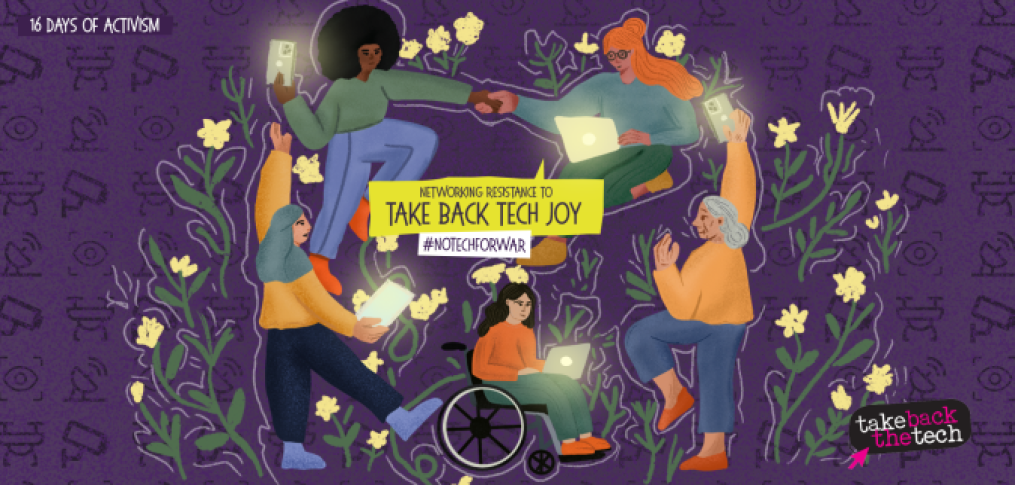
Banner for the TBTT! campaign in 2025. Image: Junaid Rana


2006 was a momentous year for digital technology, with more applications that allowed for faster and broader connectivity launched. 2006 saw the beginning of Twitter, the expansion of Facebook to include more than United States-based college students, and Google’s acquisition of YouTube. Social networking as we know it today was on its way to shaping and changing how people across all socio-political and economic realities relate inside of and with technology.
Increased access to various spaces for social networking also meant increased opportunities for violence directed specifically at women and queer and LBT+ people as well as black, poor, rural and Majority World users of these platforms. The experience of this violence was not new. For years already, the Women’s Rights Programme at APC (APC WRP) had been bringing attention to this particular experience of violence that targeted certain people online and offline. This was also the year that feminists organising and taking up space online came together to make visible, name and challenge the violence that women and queer and LBT+ people had been experiencing online.
Launched in 2006, the award-winning Take Back the Tech! (TBTT!) campaign was a rallying call for all people that use, organise with and in many ways survive digital technologies to take back space, voice and power in, with and within technology. Through various spaces and initiatives, APC WRP had been making visible the continuum of violence between online and offline spaces and raising awareness and concern about the long-term and devastating impact of online violence on people already excluded from full participation in society and decision making who had found voice, community and safety in various online spaces.
20 years later, what has changed?
This year, TBTT! celebrates 20 years of this work, and will create spaces for commemoration, reflection and renewed calls for us all to take back the tech throughout the year. To this end, the TBTT! campaign hosted a webinar as part of the Commission on the Status of Women’s 70th session (CSW70) on 18 March 2026. Organised in collaboration with APC’s Feminist Internet Research Network (FIRN) project, the webinar was titled “Where are we now? What have we learned? Reflecting on 20 years of research and action against technology-facilitated gender-based violence (TFGBV)”. It looked back at the history of the campaign as well as at the current state of TFGBV and the various ways in which APC WRP and the community of activists, organisations and actors are working to disrupt digital platforms that allow the prevalence of this violence.
This 20-year celebration takes place at a time of multiple wars across the world, notably the US-Israel war on Iran and the South West Asia and North Africa (SWANA) region, the ongoing war of Israel on Palestine and South Lebanon, and the civil war in Sudan that has led to the biggest humanitarian crisis of our time. There is also the destabilisation of Venezuela and Cuba by the United States, border clashes between Afghanistan and Pakistan, and the ongoing war between Russia and Ukraine. Weaponised technology, including weaponised digital misinformation and disinformation, play a pivotal role in facilitating the different ways in which democracy and justice are undermined both online and offline. The TBTT! campaign is turning 20 years old at a time when ideas, movements and disruptions around pervasive TFGBV remain necessary and in some contexts urgent.
The webinar held two conversations, the first one led by Erika Smith, who has been working on the TBTT! campaign since 2006, along with Florencia Goldsman from Argentina, who has been an ongoing TBTT! campaign champion since 2009 and whose work focuses on the intersection of digital rights and cyberfeminism, where she has been leading digital safety and gender-sensitive journalism training for over 10 years. Florencia and Erika shared about the various ways in which activists from different parts of the Majority World implemented creative and provocative ways of highlighting the prevalence of TFGBV in various online contexts. Notably, Florencia shared about the Señoras de Internet podcast that spoke to women who had been exploring, researching and organising collectively online. Many of the webinar attendees echoed their participation and interest in this podcast series as an important springboard for actions and ideas challenging TFGBV in the different work people were doing.
Florencia also mentioned that one of her key takeaways was connecting offline activism as part of her TBTT! campaigner work, combining street theatre skills with digital safety messages, or stencilling “https” in public places when she was campaigning in Argentina and Brazil. This memory of early TBTT! campaign work emphasised the need for both online and offline interventions. Erika also spoke about the various other projects over the last 20 years that have learned from and built on TBTT! campaign work.
Since its inception, the TBTT! campaign has seeded numerous projects over the years that have brought nuance and focus on TFGBV and the numerous ways we can take back the tech. Some examples are GenderIT.org (2006), Feminist Principles of the Internet (2014), Exploratory Research on Sexuality and the Internet (EROTICS) (2008), the All Women Count-Take Back The Tech! project (2016), the Our Voices, Our Futures project (2020), and the Feminist Internet Research Network (FIRN) project (2013), to name a few. Erika importantly pointed out that a key focus through the years of TBTT! campaign work was to consistently weave in a focus on pleasure and play, and to deconstruct the idea of the internet and other technologies as things and spaces to be “afraid of”, but rather as spaces for curious exploration.
Grounding our actions in lived realities
The second part of the webinar focused on the role that research plays in taking on TFGBV. For movement building, resource mobilisation as well as for policy advocacy in formal and institutionalised social justice work, evidence is demanded to challenge the oppressive status quo. Research has over the years been an integral locus of evidence for the varied oppressions and realities that different communities are surviving and thriving in against the odds. This session was led by Diana Bichanga, the FIRN project coordinator, and featured two FIRN researchers: Carl Jancz representing MariaLab, based in Brazil, and Gulbakhor Makhkamova representing Women’s Center “Gulrukhsor”, based in Tajikistan.
Carl from MariaLab shared about the complex but also accessible ways in which MariaLab provides support for people experiencing TFGBV and the need for feminist approaches and principles in implementing this work. An important takeaway from Carl’s presentation was the need for specific support for different TFGBV attacks, because feminist techies have always known that one-size-fits-all approaches have left many people behind. Carl’s presentation highlighted the need for guiding principles which ensure that the different approaches applied to the varied issues and contexts adhere to agreed values regardless of the person being attacked. Carl also shared that feminist techie approaches to TFGBV support must centre care and extend well beyond the initial support intervention. In some cases, the intervention may require a feminist approach involving multiple stakeholders beyond just addressing and monitoring the reported digital harm, such as referring the case for legal procedures.
Gulbakhor, the speaker from Tajikistan, spoke about the various social and cultural realities that allow TFGBV to thrive in the Tajik context. These are similar to many Majority World realities with hetero-patriarchal norms and values that create power dynamics for people to both perpetrate TFGBV as well as endure and silently suffer this violence. Most TFGBV cases involve phones and restricted access to technology, often enforced by male family members. Although the range of available and used access technologies is narrower, the research indicates a higher incidence of TFGBV, particularly against women. Gulbakhor shared that this research was the first of its kind in Tajikistan and had set an important precedent for future research as well as local policy and advocacy. A noteworthy quote from Gulbakhor’s presentation of their research is that “Online abuse is not virtual.”
These two sessions, through storytelling with TBTT! campaigners Florencia and Erika and looking at TFGBV research with FIRN researchers Carl and Gulbakhor, told the story of regional and global feminist technology activism, struggles and opportunities, and engaged with the questions of “Where are we now?” and “What have we learned?” They reflected the variety and nuance of what campaigning can look like, and how evidence and research on TFGBV, when perceived through a feminist lens, widen the opportunities for collective participation in telling the story of a lived reality. This conversation highlighted the important ways that the TBTT! campaign has over the years collected and shown the evidence of experiences of TFGBV throughout the world, but also shown the great resilience and creative interventions being initiated by feminists, activists, techies, researchers and the larger community of people that rely on digital spaces like online social networks to create movements and moments online that continue to push back against the normalisation of the experiences of violence with and within digital technologies.