#3 What makes connectivity really meaningful to people?
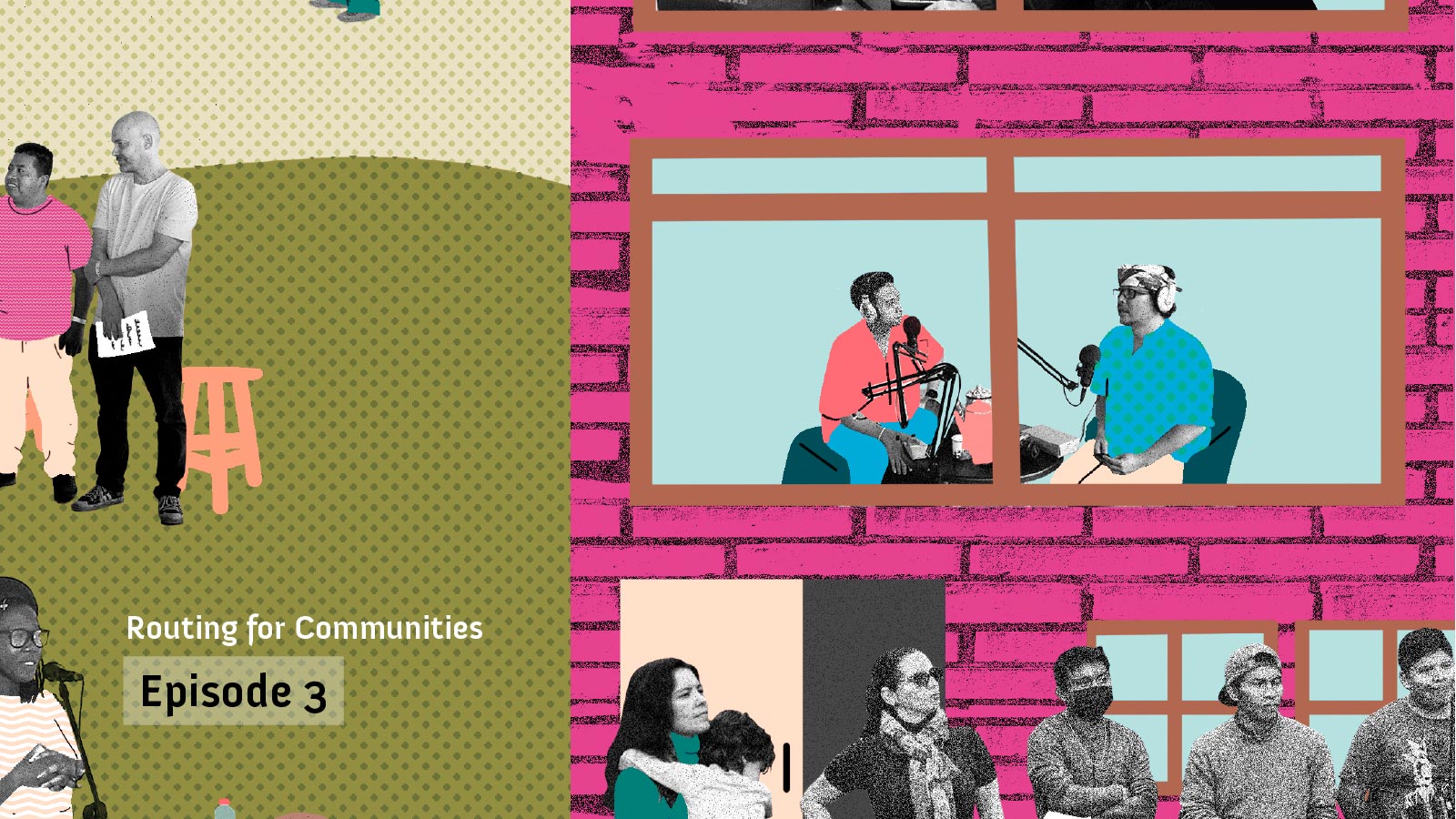
On the air: The third episode of the new season of the Routing for Communities podcast! Community-centred connectivity initiatives are complementary to the internet access offered by commercial providers and state-sponsored public networks. They help to diversify internet access markets, offering affordable and locally relevant content and service alternatives for communities.
We believe the social values of community-centred connectivity initiatives make them different from traditional stakeholders in the ecosystem. And that’s why today we're going to talk about some principles identified by the Local Networks initiative in many of these experiences. We're going to reflect on some of these principles in practice, based on the amazing interviews we conducted in season one of this podcast.
In this third episode of season 2, you will listen to parts of the following stories from the
previous season:
Podcast Transcript
What makes connectivity really meaningful to people?
“The internet is not only a new platform that can be utilised by the local communities to communicate and to access information, but also it can be very useful to enhance artistic and cultural expression.”
In this second season, we continue to address community-centred connectivity initiatives. As you know, these projects must meet communities’ needs. They must provide meaningful internet communications infrastructure or services to communities in urban, rural and remote locations. They should respond to the diverse needs and interests of communities. By doing so, also allow them to participate in their own development.
As we saw in the first season of this podcast, community-centred connectivity initiatives are complementary to the internet access offered by commercial providers and state-sponsored public networks. They help to diversify internet access markets. They offer affordable and locally relevant content and service alternatives for communities.
We believe that the social values of community-centred connectivity initiatives make them different from traditional stakeholders in the ecosystem. And that’s why today we’re going to talk about some principles identified by the Local Networks Initiative in many of these connectivity alternatives.
These principles were published on the APC’s website in 2024, and we’ll leave the links so you can explore them in the description of this episode. Today, we’re going to reflect on some of these principles in practice, based on the amazing interviews we conducted in season one of this podcast.
I’m Thiago Moyano, from Brazil. If you don’t know me yet, I’m the host of season two of the “Routing for Communities” podcast. Join me to listen to voices from different countries who will share with us diverse connectivity experiences built by the communities themselves.
This is Routing for Communities, an audio journey tracing community connectivity around the world, season two, episode three.
“We’ve done it and we’ve done it really, really well and it works and it’s viable and it’s economical and it’s owned by the people. It’s looked after by the people.”
That’s Chris Conder, one of B4RN’s founders who was recognised by Queen Elizabeth II for her work in taking the internet to rural communities.
B4RN stands for Broadband for the Rural North. This is a community benefit society in England, which means that the organisation must serve the broader interests of the community, and that any surpluses must go right back into the community. The members themselves own the initiative that provides internet connection to the people of many villages. That’s the principle of being participatory.
In the early 2000s, Chris and the others organised themselves to seek solutions to the internet access gap they experienced.
“Each of those people brought different skills to the pot. So one was an accountant, one was an engineer, one was a doctor. There were all different mindsets of people on the management committee. And Barry drew up a business plan which we kept inspecting and looking at and adding things to, but it was Barry’s genius plan. And we went to the city council, who were going to be our sponsors, because we weren’t anybody, we were just a management team of community nutcases.
So the project would be fronted by the city council, who were fully supportive of getting the internet to eight of their parishes, at no cost to themselves, because this was a grant. And so, three quarters of a million pounds according to our plans would have built a backbone. So, from a breakout point of dark fibre, we could then feed our own fibre to our eight communities.”
As you can see, B4RN enables the community to shape the infrastructure, or services, by participating in developing its community-centred vision and its deployment, operations and use. Community-centred connectivity initiatives can also improve the personal, social, political and economic lives of people living in the community. Particularly for those who are structurally marginalised, such as women, the youth and elderly, refugees, racial and ethnic minorities and people with disabilities.
These initiatives enable communication rights and other rights of community members. For example, education and health care, as well as the collective rights of communities, including racial and ethnic minorities, and people living in marginalised or at-risk territories. That’s why the principles of well-being and human rights are interconnected in several community-centred connectivity initiatives.
Like the Amadiba community network, a project that has been strengthening the community's fight to defend their land, the coast of their country and their people, through access to the internet on the coast of South Africa. Lungelo Mtwa tells us more about it.
“My village, Amadiba, is like the old Pondoland. We are a rural village, which some people from outside the area, they regard us as primitive people. They say we are living in the past, because our village is still very natural, very raw.
And our houses are actually scattered, maybe 500 meters in between, from one house to the other. That space, between the houses, between the homesteads, we use it for farming, we also use it for grazing. So we are in a rural area which is close to the ocean, very unspoiled ocean, a very wild ocean. Our area is, our coast actually, is known as the Wild Coast, because there’s not much building along the coast. It is beautiful, there are waterfalls plunging into the ocean.
We have creeks, we have forests, we have hills, we have, across my village, we have a game reserve, Mkhambathi Nature Reserve, where you see many animals.
And our people are still practicing the old ways, as people say. We are still clinging on to our culture, our religion. We still know that a person is a person because of the next person, of the other person. So, we have a thing called ‘ubuntu’. Ubuntu means humanity. Ubuntu means ‘I am because you are’.”
Amadiba lives not only on its natural beauty and the preservation of its traditions. But it is also known as a community that is threatened by a titanium mining project that has met strong rejection from the local community, as well as resistance, for decades.
And this leads us to another principle for community-centred connectivity initiatives: environmental awareness. They must design the infrastructure or services in a way that contributes to the preservation of the environment and biodiversity of the territory, and with care for communities in those territories as well.
“Our reasons why we are fighting against this mining and stuff is because we know that we are Indigenous people of this land, and then we are belonging to the land, we are dependent on the land. We know that we are going to be moved once the money comes in, we are going to be relocated.
Having Wi-Fi in the community will be very helpful. As I’m saying we have many stories to share with the world, we have struggles and victories.”
Community-centred connectivity initiatives should also actively seek to understand the gender power dynamics and the different lived experiences within a community. This principle is so important that we transformed it into a whole episode of our podcast. If you haven’t listened to episode two yet, don’t miss it.
But, for now, let’s listen to a woman’s voice from Nigeria on the topic.
“My name is Harira Abdulrahman Wakili, from Kano, Nigeria. I’m 28 years old. I’m working in the area of digital inclusion, gender marginalisation and also working in the area of promoting women’s participation in digital spaces, as well as promoting women’s participation in politics, women’s participation in decision making, among others.
An example of one of the communities is Pasepa community, it is a community whereby they have a combination of traditional rulers and youth, so they were very active. At the beginning of the community network project, we discovered that both the young and elderly people in the community are very active when it comes to advocacy, when it comes to promoting their community issues and all of that.
But one thing we discovered in Pasepa community is that there’s low participation of women. At the beginning of the project, we tried to focus on women working together with the stakeholders in the community, with the local stakeholders, to see that we sensitise them and educate them on the power of women in the community and the importance of women coming out to support, to participate in the community-based activities. Because we believe that if the elderly people will be active, the male youth of the community will be active, so definitely there are women’s issues that are yet to be addressed in the community.”
Sustainability is also a principle for community-centred connectivity initiatives. They must sustain their operations considering local economic practices and values.
B4RN, in northern England, is a good example of that. The average cost for broadband in the United Kingdom is around 0.86 pence per megabit per month (almost USD 1). B4RN’s official price is closer to 0.03 pence per megabit. In other words, the network built by the community offers high-quality connectivity at significantly lower cost for the users.
Another experience, in the countryside of Colombia, shows us how community-centred connectivity initiatives value local culture, another fundamental principle. We’re talking about the Jxa'h Wejxia Casil Community Network, in an Indigenous community. To tell you more about it, we spoke to Edinson Camayo, Indigenous leader and the project’s coordinator. He is a member of the Nasa Indigenous nation and starts speaking in the Nasa Yuwe language.
Colombia’s census statistics revealed that the percentage of Nasa people still speaking their own language was rapidly decreasing. In 2018, that number was down to 40%. How could they change the situation? One of the instruments was information and communication technologies.
“And that’s when we realised that we have to have technological autonomy and relevant communication. And then, we said: ‘Well, we’re offline here’. So, we started to work on it. And that’s when we started with the internet, audiovisual communication, stations that were already in place but to which we had lost access due to equipment damage. That’s how we’re going to become stronger.
We have already entered not only the internet, but we have also begun to strengthen, let’s say, the 2G mobile community right now. This is used for security only, exclusively by the Indigenous guard. But we also said among our people… We said, ‘We are going to buy a transmitter, a transistor, for a television’ and we also have a community television right now, but our dream is to reach almost a regional level, and we are projecting that.”
Community-centred connectivity initiatives sustain local cultures, traditional activities and languages, particularly those that are under threat. They provide relevant and meaningful content in local languages in an inclusive and accessible manner.
Like in Indonesia, where the Common Room Networks Foundation works with art, culture, communication and new technologies.
“My name is Gustaff, Gustaff Harriman Iskandar. I work with the Common Room. We have been learning a lot that the community network is not merely about the physical internet infrastructure per se.
In order to have an appropriate approach on intimate developments among rural communities, we also need to conduct a cultural approach and recognise local culture and traditions, because the internet is not only a new platform that can be utilised by the local communities to communicate and to access information but also it can be very useful to enhance artistic and cultural expressions”.
What else? Well, community-centred connectivity initiatives are also related to ownership. They strive for community ownership of the infrastructure or services, through open and inclusive participation in its governance and management.
All examples of experiences around the world mentioned in this podcast involve different network governance and management models. But all of them are participatory and focused on the community.
If you are interested in the subject, go to the description of this episode on your audio player to get access to the materials we have separated for you.
These kinds of community initiatives many times also build technical capacity in the community to maintain and operate the infrastructure or services. They can also represent an opportunity to build the digital capacity of users to make informed decisions about their internet use and to benefit from social and economic opportunities online.
Community-centred connectivity initiatives are also connected to others. They have been sharing their lessons and experiences to support collective, multistakeholder actions. These projects are unique for each local reality. They are tailored to their specific environments and communities. There is no single standard to be replicated around the world. But all community-centred connectivity initiatives are “meaningful” when they respond to the needs and interests of a community, as defined by the community.
Principles like those we presented today have been developed by the Local Networks Initiative through an extensive consultation process with community-centred connectivity initiatives working in different regions across the Global South. They do not seek to romanticise these experiences nor erase their challenges. Nor are they a formula to make everyone fit in. However, they have achieved results in practice that can inspire us to reflect on connectivity models and alternatives.
If you are interested in the subject, go to the description of this episode on your audio player to get access to the materials we have separated for you. Among them, you’ll find a publication with all the principles in full. In it, the Local Networks Initiative explains that while the principles were developed to help communities discuss their priorities when setting up an initiative, some are considered fundamental to any community-centred projects. These include being focused on the community’s needs, being participatory, working with supportive external stakeholders and strengthening the community’s well-being.
Other principles are aspirational or achievable over time and may not be central to all initiatives. For example, some may operate with a social business model, without focusing on community ownership. These principles can evolve, but we believe they should form the foundation for any community-centred connectivity initiative in unserved or underserved communities.
“What makes a community network different from a commercial service provider? With a community network, you can add on so many things that provide solutions for the community.”
If you listened to episode one of this season, you will remember Professor Kanchaná Kanchanásut, from Thailand, who has been working for many years in the mission to close the digital gaps in her country.
“My name is Kanchaná Kanchanásut. I am from Thailand and I work at the Asian Institute of Technology. “
Her work is also very inspiring and pioneering, especially for women.
“The idea of community network is not popular in Thailand because we are used to having governments to build infrastructure, whether it be telecommunications or, you know, roads or anything. So people have that kind of mindset.
So what we did is something that we believe is useful but it’s not in the eyes of the majority of the people, right? Many people, once they get to know our projects, they say ‘Ah, very nice, very good idea’ and so on but it’s very hard for someone to try to duplicate what we are doing. And you know, try to do it in other provinces, it’s not that the concept is good, but it’s not yet when you know why we adopted it. I think we need to work hard on this and I think that the concept of having the local community build their own network, particularly for those remote villages. We promote communities, they should be able to decide what they want to do with their own community. They should not sit and wait for the provider to come and this type of thing.
So, we are trying to convince people to go in this direction. Of course, we talked to government people, we talked to regulators and tried to at least make them aware of this type of approach and try to not abandon community networks. And try to at least, you know, make use of the concept in areas that their provider could not go into. We don’t want people to wait forever. We want to close the gap.”
If you liked this podcast, please recommend it to those you know will appreciate it as well. If you want to know more about the projects we talked about here, check out the links we have provided in this episode’s description.
Just reminding you that all the interviews we’ve heard today were recorded in 2023 for season one of the podcast. The information and perspectives shared were made in that context. In the episode description, as always, we’ll include up-to-date information and links to resources that help continue this conversation.
You can follow season two on the main podcast platforms or on APC’s website: routingforcommunities.apc.org. In our next episode we’ll talk about public policies, regulation and financing networks. Don’t miss it!
You just listened to episode three of season two of “Routing for Communities: An audio journey tracing community connectivity around the world”. This is the podcast of the Local Networks Initiative, a collective effort led by APC and Rhizomatica. Production: Rádio Tertúlia.
Thanks, and see you next time! Bye!
Credits
This podcast is an initiative from the Association for Progressive Communications (APC) and Rhizomatica, produced by Rádio Tertúlia. Presentation: Thiago Moyano. Script, editing and sound: Beatriz Pasqualino. Interviews: Vivian Fernandes. Coordination: Beatriz Pasqualino and Débora Prado. Consulting Board: Carlos Rey-Moreno, Flavia Fascendini and Kathleen Diga. Illustrations: Gustavo Nascimento. Webdesign: Avi Nash and Cathy Chen.
This production is part of the “Meaningful community-centred connectivity” project being implemented by the Local Networks (LocNet) initiative, with financial support from the Swedish International Development Cooperation Agency (Sida) and UK International Development from the UK Government through its Digital Access Programme. The views expressed here do not necessarily reflect the supporters’ views.






This podcast is an initiative from the Association for Progressive Communications (APC) and Rhizomatica, produced by Rádio Tertúlia. Its production was supported by the “Connecting the Unconnected: Supporting community networks and other community-based connectivity initiatives” project with support from the Swedish International Development Cooperation Agency (Sida); and also by the project “Supporting Community-led Approaches to Addressing the Digital Divide” with support from the UK government through its Digital Access Programme.