#2 How are women changing networks, and networks changing women?
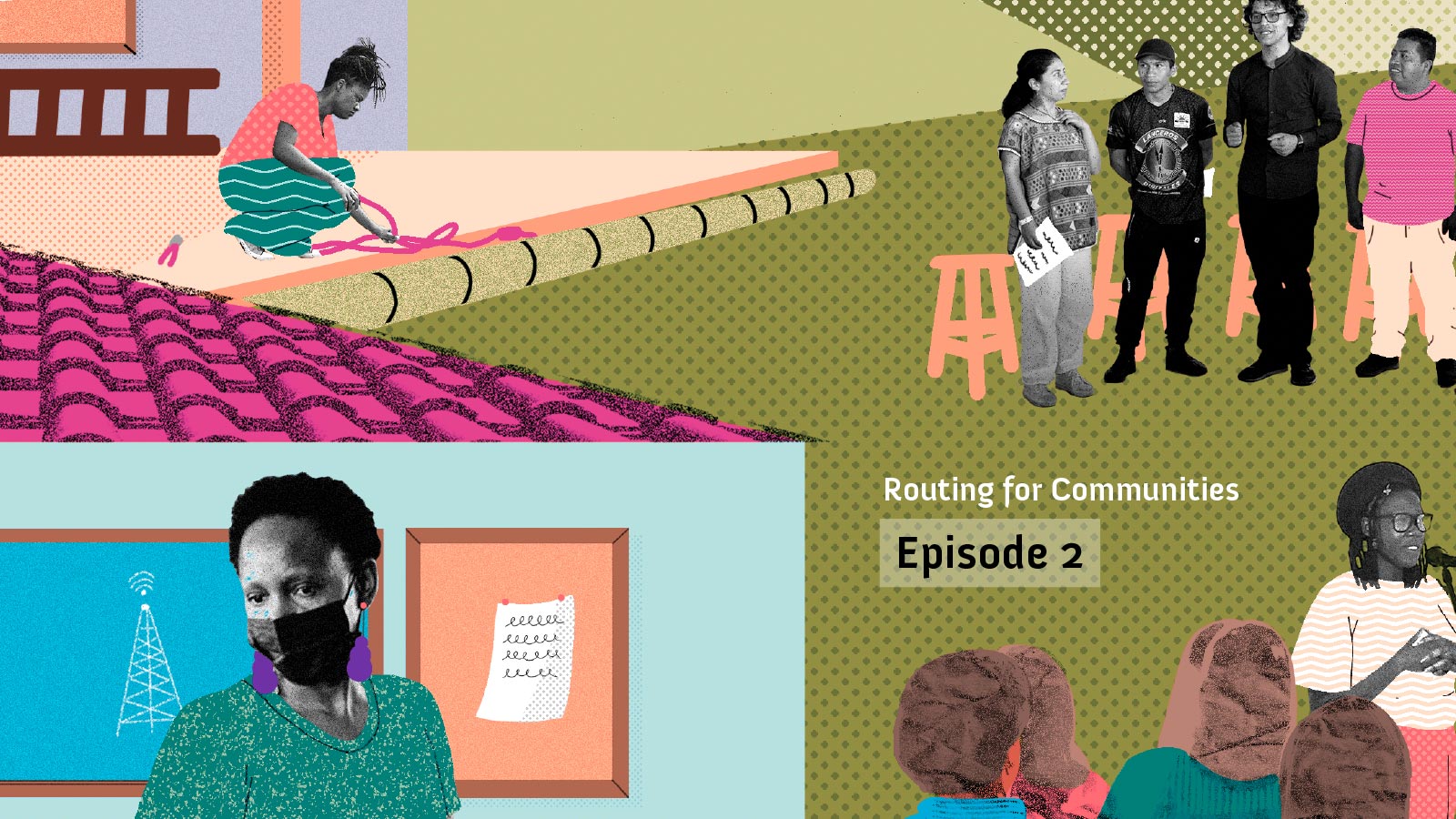
While women continue to make essential contributions to the development of community-centred connectivity initiatives worldwide, they still face challenges that echo structural power imbalances and historical inequalities.
Digital technologies and decision-making processes are typically designed by men, with no gender-responsive lens. As an extension of the society in which they are embedded, these processes often reflect the normalisation of centuries of structural exclusion and violence. And these are always related to factors such as gender, race, class and nationality, among others.
The voices of women offer important reflections on the barriers they face – but also highlight how they overcome them. As protagonists in this field, they also offer a deep knowledge of the achievements and challenges faced by community networks in different contexts.
Episode 2 of the new season of the Routing for Communities podcast is on the air! Join us on an audio journey as we explore fundamental questions in the field of community networks, seen through the perspectives of women from a range of countries who play various roles – from hands-on technical work to national and international advocacy for better policies and regulation.
Podcast Transcript
Hello! It´s me again: Thiago Moyano, from Brazil. I'm the host of season two of “Routing for Communities” podcast. In this four-episode season you'll hear stories and voices that are intertwined, connected by one thread: building internet and communication community networks.
In this second season, we are revisiting the interviews we made in season one, back in 2023. In season one you listened to life stories of those who create innovative community lab projects to connect people in areas that are still living offline. The topic provided us with a lot of content, so we decided to extend the conversation into more episodes for you. And did you know that in 8 out of the 12 episodes we launched in 2023, our main interview was with a woman?
This alone is a clue to the crucial role they play in building connectivity alternatives that focus on their communities. While women continue to make essential contributions to the development of initiatives worldwide, they still face challenges that echo structural power imbalances and historical inequalities.
Women's voices offer important reflections on the barriers they face, but also show how they overcome them. As protagonists in this field, they also offer a deep knowledge of the achievements and challenges faced by community networks in different contexts. In this episode of season two, we revisit some of the reflections.
So join me on this audio journey where we'll explore fundamental questions in the field of community networks, seen through the lens of women from a range of countries. They play various roles, from hands-on technical work to national and international advocacy for better policies and regulation. How about we listen to them together now? Let's go!
This is Routing for Communities, an audio journey tracing community connectivity around the world, season two, episode two.
Digital technologies and decision-making processes are typically designed by men, with no gender-responsive lens. As an extension of the society in which they are embedded, these processes often reflect the normalisation of centuries of structural exclusion and violence, related to factors such as gender, race, class and nationality.
So, looking at this scenario, we have some questions… How are women connecting their communities? What difference do women make in the creation (and continuity) of community networks? What difference do community networks make in women's lives?
Not easy questions, right? So, we will start thinking about possible answers here. First, let´s go to Brazil, my country.
Yes, gender disparities persist nowadays all over the world. And in addition, there are many other disparities visible in the digital gaps. That's why we're now going to talk about the experience of Casa dos Meninos, or “The Boy´s House”, in a free translation to English. This is an initiative working on information and communication technologies with youth in the outskirts of the city of São Paulo - one of the most populous cities in the world. More than 11 million people live here, where our studio is also located.
This social non-profit organisation has several work groups led by local women, and one of them is dedicated to learning more about infrastructure related to community networks, such as servers.
Here in Brazil, more than half of the population is black. We must remember that racism is a systemic issue, not only an individual one, and our reality is also marked by struggles and fights involving the world of technology and access to connectivity. That's why the interviewee that you will listen to now emphasises, in this debate, connecting gender, race and class.
“I'm Daiane Araújo dos Santos. I’m 33 years old and I'm the middle child of three siblings. In a way, I used to question my parents about the different treatment they gave my brothers who had a bit more freedom than I did, being a girl. And in 2010, we started working with the community network, with the perspective of creating a common base for people, a common base of information, communication, and also the wealth within our territory.
We began to build the community network. We distributed it, we installed the antennas in the community and distributed internet from The Boy's House. The position of a community network from a black and female body is very lonely. Because we are talking about social structure, where your body, from the moment you arrive, will be noticed because you are the only black person in the place.
From this perspective of representation, it is a lonely and exhausting place because you end up taking on a lot of responsibility to try to be in almost every space, which is very heavy. I think we have advanced and are advancing a lot in the debate on gender and race and I want to bring up class because many people forget that they are poor.
So I noticed the issue of gender and race discussion in this context as well, in the broader and political discussions happening around the world, specifically in Brazil, there are these two areas of discussion about technology. There is a place to understand how it is socially constructed in the world, how it is culturally appropriate, but there are also spaces to reconstruct, resignify and reuse technological tools for better living conditions for everyone. Today I feel much better because the gender debate is much more widespread in society, perhaps in technologies, but the race debate is not, the race debate is still very, very, very far from where I would like it to be.”
Women can play different roles and are playing them, helping to strengthen this field while making it more inclusive. This can only be done by thinking about gender, race, ethnicity and class, among other power relations and digital divides.
And that's exactly what we can see from another Latin American experience, which Flor Lino is part of, in Mexico. Do you remember hearing her story in episode one of season two? So, let's listen to Flor once again, but talking now about these aspects of gender and ethnicity from the point of view of an Indigenous woman.
She is part of a singular experience: Wiki Katat, the first Indigenous virtual operator providing internet and mobile phone services in Mexico. In her territory, there is also a community radio station: Tosepan Limakxtum, which spreads and values local culture.
“My name is Floriberta Lino de Jesús. I am from a community called Tepetzalan, in the state of Puebla, in Mexico. I am a proudly Indigenous woman. Something that has marked me a lot is what happens here in the communities, or in the Indigenous towns. I speak of Cuetzalan, from my territory, but I speak of all the Indigenous communities of Mexico and all the Latin American countries because I'm totally sure that many women sometimes, it's not because they don't want to make use of technologies, sometimes we don't have the resources, or it's not because we don't want to prepare ourselves, continue preparing, gaining more knowledge, because sometimes we live far from our university. Or far from having access to this thing, like the internet, and that's why we at the radio, we are thinking a lot about how to integrate these new women to make the networks just a pretext to reconnect with other women and to be visible, to say that women can also do it for other women.
Putting myself in their shoes, sometimes it's not that they don't want to. It's just that sometimes the circumstances, the situation, or the resource, they don't let you keep preparing yourself in the communities. It's not the lack of desire, we have a desire to keep improving ourselves as women and to gain knowledge, but it's the resources and situations that hold us back.”
From Mexico, let us now travel to Kenya. Risper Arose has studied gender and development. She started working with community networks in 2020, after graduating from college. She is part of Tanda CBO, a Kenya-based organisation promoting community-centred connectivity initiatives and digital inclusion in the country. Tanda is a Swahili word for “to spread”, and that is what Tanda CBO is determined to do.
This organisation is based in Nairobi, in the heart of Kibera - the largest informal settlement in Africa, and out there the internet is an absent essential service.
Tanda CBO developed TandaNET (formerly TunapandaNET), the first urban community network in the country. Their goal is to enable the community to access better local services and use them to improve their livelihoods.
“My name is Risper Akinyi Arose. I was born and raised in Kibera and I'm the third born in a family of five siblings. Now my work was to engage the community to see how they utilise the internet to create capacity building, for the community to understand the benefits of the internet, to make sure that our work was very gender-sensitive and that we are targeting both men and women. And also to curate interventions where the communities would now not only just consume the content that was already online, but also start thinking of ways that they can produce content that matters to them.
We had training on a digital literacy basics, on how to use Zoom to mobilise, how to protect oneself when engaging in the online space, how to make sure they amplify their voices using different platforms. We also talked about podcasts - using podcasting to make sure that they can still create awareness around the different areas that they are working on, such as sexual reproductive health and all that.
And also through that we curated content on arising issues such as online gender-based violence where we had the women sharing the experiences of online violence through a podcast. So that it can then be listened to with the entire community. And this was in collaboration with the community radio, that we were working with, to make sure that this content gets to the community, and also just posting it in the different podcasting platforms and making sure that these activists have this content to go back to and give it to the communities that they are serving.
Gender is very key in any programme, not necessarily just for connectivity, but any programme to be able to understand that women’s and men's needs are different and even within the women. Because women are not like a homogeneous group, like even with women you still need to dissect and make sure that the interventions are very very specific to different kinds of women.”
As you can see, women can play different roles when it comes to community networks. In a rural area in Argentina, for example, we have the project Quintana Libre, a community network in the township of José de la Quintana, which was developed with the local community by an organisation called Altermundi. This town has a little over 4,000 people and is located in the province of Córdoba, which is Argentina's second most populated province.
Our next interviewee is one of the founders of Altermundi. She coordinated and followed more than 20 community-led networks from their birth to their development. Let's meet her, a woman who among other things, works with the technical aspect of the Quintana Libre project.
“My name is Jessica Giudice, I'm 37 years old. I discovered the concept of free software about 20 years ago. From the very beginning it excited me a lot. It was love at first sight, something like that. Gradually, I got involved in events. I felt that my role was to connect people who wanted to learn with those who could teach and to provide the necessary materials and space to make that happen.
And that was my cherry on top. It led me down an endless path towards community networks. I fully immersed myself in that when I moved here to the town where I live, and the need for connectivity was to bring it to the rural environment, a place where improving telecommunications was really necessary.
The community network has taught me, inspired me, and educated me, not just in technical content, but also in timing of relationships and learning from both sides. It's always about maintaining and promoting that community networks are part of the public debate from this side, the side of community networks, the side of social organisations, the side of community radios. We are not the government. We are resistance. We are continuity. We are always there, always hungry to create, hungry to grow, hungry to be heard, to intervene, to change reality, to improve the reality we live in.”
But tell me, whose voices are heard in policy and regulatory spaces? What are our gendered experiences in these spaces? How can we build more inclusive, diverse and community-oriented access policies? These are questions that need to be at the centre of the debate about digital gaps.
After all, we know for example - that while there is currently a fair amount of access to training grants for women, there is limited funding available to women for the implementation of projects. There is a need to move beyond the mentality of just training women, to supporting initiatives in which women play an active part in different roles.
That's the challenge for women who work in this context. Women like Josephine, who lives in Kenya. She is the current policies coordinator in Africa for the Local Networks Initiative, which supports community networks across the globe. At APC, Josephine works towards the advocacy of regulatory policies and environments to support community-led networks.
“My name is Josephine Miliza and I live in Nairobi, Kenya. My background is in network engineering. I grew up in rural Kenya. I think in the grander scheme of things I always gravitated to work that looked to resolve issues around inequalities. So, whether it is inequalities in terms of access to education or inequalities in terms of access to opportunities that are available online.
I started working in community networks in 2015, when I joined an organisation called Tunapanda. Since then, I have championed the community networks movement here in Kenya, being a pioneer starting the first committed work in Kenya and then to also supporting several other community networks, not just in Kenya but also across the continent.
There's a gender digital divide that's important to be addressed, but also, we need to be able to have policies to mainstream agenda, when it comes to policy and regulation. A way to do this is by ensuring that more women are actually involved in policy advocacy work, especially in the telecom ecosystem. However, currently there are not that many women, especially with the gender digital divide when it comes to technologies.
So as part of the APC LocNet project, there's a programme called Space, which provides a space for women to come and learn about the telecom ecosystem, as well as how they can be able to advocate for enabling policy and regulatory environments in their countries. I think this is very important as a way to ensure that even as we are closing the digital divide, we are not widening it by having the gender digital divide. And that the spaces are safe, where women can be able to access the internet safely, which look at also the other roles that women play in their communities and their families, and ensure that access to the internet or access to technologies also looks into these aspects and addresses those particular aspects. And then, just finally, ensuring that the voices of women are incorporated when it comes to policy and regulation.”
And it is with this sense of hope, with the resilience of women, that the seed of community networks continues to be planted around the world. Here's someone who can help us expand on these reflections.
“My name is Claire Milne. I'm retired from a career which was principally in telecommunications policy around the world. and I'm very happy to be working with APC on their community network projects.
I think, as a generalisation, women are often the best communicators. They are traditionally the people who hold families together, who everybody talks to and uses as the hub point to find out about other parts of the family.
And they're the best connected within their communities too. So they've got vital roles to play in bringing people together and resolving conflicts. and there will be conflicts in any major project in a community like this one. So I think the women are often the best place to get things started on a community network and then when you get to the point of actually building a network, well, of course women are fully capable, when they're trained, of carrying out the technical work involved in a community network.”
And we hope these stories we shared with you in this episode inspire you to act and help build solutions to digital divides in communities around the world. If this is a topic that moves you, we will leave links to more materials and stories about gender and community networks in the description of this episode. Among them, you will be able to discover initiatives that seek to strengthen the participation of women and gender diverse people in different spaces, such as women's circles and training and mentoring programmes.
If you liked this podcast, please recommend it to those you know will appreciate it as well.
If you want to know more about the projects we talked about here, check out the links we have provided in this episode’s description. Just reminding you that all the interviews we've heard today were recorded in 2023 for season one of the podcast. The information and perspectives shared were made in that context. In the episode's description, as always, we'll include up-to-date information and links to resources that help continue this conversation.
You can follow season 2 on the main podcast platforms or on APC’s website: routingforcommunities.apc.org.
Community-centred connectivity initiatives are complementary to the internet access offered by commercial service providers and state-sponsored public access networks.
They help to diversify internet access markets, offering affordable and locally relevant content and service alternatives for communities.
However, we also believe their social values make them different from traditional stakeholders in the ecosystem. And that's why, in our next episode, we´ll talk about the principles that make them different from those traditional operators. Don't miss it!
You just listened to episode 2 of season 2 of “Routing for Communities: An audio journey tracing community connectivity around the world”. This is the podcast of the Local Networks Initiative, a collective effort led by APC and Rhizomatica. Production: Rádio Tertúlia.
Thanks, and see you next time! Bye!
This podcast is an initiative from the Association for Progressive Communications (APC) and Rhizomatica, produced by Rádio Tertúlia.
Presentation: Thiago Moyano.
Script, editing and sound: Beatriz Pasqualino.
Interviews: Vivian Fernandes.
Coordination: Beatriz Pasqualino and Débora Prado.
Consulting board: Cynthia El Khoury, Luisa Bagope, Flavia Fascendini and Kathleen Diga.
Illustrations: Gustavo Nascimento.
Web design: Avi Nash and Cathy Chen.
This production is part of the “Meaningful community-centred connectivity” project being implemented by the Local Networks (LocNet) initiative, with financial support from the Swedish International Development Cooperation Agency (Sida) and UK International Development from the UK Government through its Digital Access Programme. The views expressed here do not necessarily reflect the supporters’ views.





This podcast is an initiative from the Association for Progressive Communications (APC) and Rhizomatica, produced by Rádio Tertúlia. Its production was supported by the “Connecting the Unconnected: Supporting community networks and other community-based connectivity initiatives” project with support from the Swedish International Development Cooperation Agency (Sida); and also by the project “Supporting Community-led Approaches to Addressing the Digital Divide” with support from the UK government through its Digital Access Programme.