


¿Eres periodista?
En esta sección encontrarás comunicados de prensa, publicaciones, material multimedia y una lista de contactos de la comunidad APC, todas personas comprometidas que trabajan sobre internet como forma de mejorar la vida de la gente, con especial atención al Sur global.
Si quieres más información, escríbenos a communications@apc.org.
para recibir nuestros comunicados de prensa.
APC en los medios
-
The Draft UN Cybercrime Convention: A threat to human rights
27 Marzo 2024 | Fair Observer | English
-
27 Marzo 2024 | Europe's Internet News Press Wire | English
-
CSW68 Emerging Issue: Artificial Intelligence
25 Marzo 2024 | Women in New York | English
-
13 Marzo 2024 | Media activism and politics | English
-
CITAD, partners present N26m Digital Hub to Jama’are community
06 Marzo 2024 | Leadership Nigeria | English
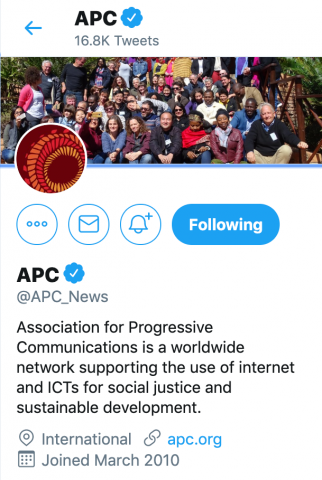
Follow our daily updates on Twitter: @APC_News
Comunicados de prensa
En nuestra comunidad podrás contactar a personas con conocimiento y experiencia en materia de:
Equipo
- Namita Aavriti Malhotra, Co-gerente: Desarrollo de conocimiento
- Marwa Azelmat, Women's Rights Policy Advocacy Coordinator
- Carlos Baca Feldman,
- Sarbani Banerjee Belur, Coordinadora regional de Asia, proyecto redes comunitarias, subsidio Gram Marg Rural Broadband
- Karen Banks, Directora de operaciones y gerente de finanzas (interim)
- Carla Barbosa Oliveira, Coordinadora de subsidios
- Roxana Bassi, Coordinación del equipo técnico
- Valeria Betancourt, Responsable de programas: Liderazgo de gobernanza de internet
- Valeria Betancourt, Responsable de programas: Liderazgo de gobernanza de internet
- Nils Brock, Coordinador de Pathfinder (implementador Rhizomatica), proyecto de Redes comunitarias
- Avri Doria, Consultora en investigación
- Cynthia El Khoury, Coordinadora de género y participación de las mujeres, proyecto de Redes comunitarias
- Anriette Esterhuysen, Consejera senior de gobernanza de internet regional y global
- Verónica Ferrari, Coordinadora de incidencia política global
- shawna finnegan, Liderazgo en justicia ambiental
- Chat Garcia Ramilo, Directora ejecutiva
- Mike Jensen, Coordinador de APC Labs, proyecto redes comunitarias
- Mike Jensen, Coordinador de APC Labs, proyecto redes comunitarias
- Hija Kamran, Coordinadora de contenido y editora del Programa de derechos de las mujeres y GenderIT.org
- Paula Martins, Responsable de incidencia política global
- Josephine Miliza, Coordinadora regional de África (implementador KICTANet), proyecto Redes comunitarias
- Jan Moolman, Co-gerente del Programa de derechos de las mujeres
- Peace Oliver Amuge, Responsable de estrategia regional para África
- Débora Prado, Ayudante de comunicación en el Programa de acceso local
- Pavitra Ramanujam, Líder de derechos digitales en Asia
- Pavitra Ramanujam, Líder de derechos digitales en Asia
- Carlos Rey-Moreno, Co-gerente: Estrategia y políticas
- Shivi, Apoyo en los encuentros "Más cerca que nunca"
- Smita, Coordinadora de proyecto Our Voices Our Future
- Erika Smith, Coordinadora de capacitación y redes
- Mehar Un Neesa, Coordinadora de administración del Programa de derechos de las mujeres
- hvale vale, Facilitación de estrategia Closer than ever (Más cerca que nunca)
- Karla Velasco Ramos, Coordinadora de incidencia política de derechos de las mujeres
- Karla Velasco Ramos (until January 2023) , Coordinadora regional de Latinoamérica (implementa REDES AC), proyecto Redes comunitarias
- Liy Yusof , Administradora ejecutiva
- Bruna Zanolli , Rhizomatica Innovation, Technology and Sustainability co-coordinator, community networks project
Miembro
- AlterMundi
- Anriette Esterhuysen
- Ariel Barbosa
- Associació Pangea - Coordinadora Comunicació per a la Cooperació
- ASUTIC
- Avri Doria
- Bangladesh NGOs Network for Radio and Communication
- Body & Data
- Bytesforall Bangladesh
- Centre for Multilateral Affairs (CfMA)
- Colnodo
- Community Education Computer Society (CECS)
- Damián Loreti
- Derechos Digitales
- Eiko Kawamura
- eQualit.ie
- Foundation for Media Alternatives
- Fundación Escuela Latinoamericana de Redes (EsLaRed)
- Gayatri Khandhadai
- guifi.net
- Helen Belcastro
- Internet Freedom Foundation
- Jac sm Kee
- Jane Coffin
- Japan Computer Access Network (JCA-NET)
- Jeanette Hofmann
- Joy Liddicoat
- Kéfir
- Kenya ICT Action Network (KICTANet)
- Koliwe Majama
- Korean Progressive Network Jinbonet
- LaborNet
- Mai Ishikawa Sutton
- May First Movement Technology
- Metamorphosis Foundation
- Michael Jensen
- Moses Owiny
- Muriuki Mureithi
- Nodo TAU
- Núcleo de Pesquisas, Estudos e Formação (Nupef)
- One World Platform
- Open Net
- Pablo Accuosto
- Patience Luyeye
- Pollicy
- Poncelet Ileleji
- PROTEGE QV
- Rafik Dammak
- Rhizomatica
- Social Media Exchange (SMEX)
- Society for Promotion of Alternative Computing and Employment (SPACE)
- Sol Luca de Tena
- Stéphane Couture
- Sursiendo
- Sylvia Cadena
- TEDIC
- Thai Netizen Network
- Towela Nyirenda-Jere
- Towela Nyirenda-Jere
- Unwanted Witness
- Voices for Interactive Choice and Empowerment (VOICE)
- Zaina Foundation
- Zenzeleni Networks NPC
Publicaciones
Colaboraciones con medios

Pikara
Colaboramos con Pikara Magazine, revista digital con una edición anual en papel que incorpora la perspectiva de género y la mirada feminista en la concepción del trabajo periodístico.
Enlace al sitio web
Rising Voices
Colaboramos con Rising Voices, proyecto de Global Voices, en la promoción de contenido sobre acceso local, redes comunitarias y diversidad lingüística.
Enlace al sitio webMás sobre APC
Llevamos más de 30 años proporcionando acceso a personas y comunidades que quieren usar internet para mejorar sus vidas y construir un mundo mejor, con conciencia de género. Acompáñanos en esta lucha contra los intentos de restringir el acceso y a favor de redes independientes que ponen los derechos de las personas en el centro.