
News
Human rights belong to people, not to networked computers
![]()
Former New Zealand human rights commissioner Joy Liddicoat has just joined APC to lead a new Internet Rights are Human Rights campaign. Although she is busy getting ready for Internet Governance Forum consultations on May 18-19, she took a few moments to talk to APCNews.
World Press Freedom Day - Take Back the Tech! to defend your right to communicate
On May 3 join a global day of action to defend our right to share information and opinions freely online – and be our own media!
APC welcomes its first member in Paraguay
One of Paraguay’s most widely-listened to community radio stations, Radio Viva, has recently joined the APC community as a member through its parent organisation, Asociación Trinidad Comunicación, Cultura y Desarollo. Asociación Trinidad works towards the democratisation of communications and improving civil participation through solidarity in action for a sustainable Paraguay. One of the many ways it achieves this work is through Radio Viva.
Cambodian villagers take back the tech to end violence against their neighbours
![]()
In Cambodia women are traditionally considered subordinate to men and violence a socially acceptable way to resolve domestic conflicts. Now a grassroots group has brought together the locals and police in 25 villages using education, mobile phones and ham radios to break the silence that keeps violence against women a terrible family secret as part of APC’s Take Back the Tech!
New research on sexuality and the internet is an “eye-opener”
“It was an eye-opener,” says privacy advocate Gus Hosein when he talks about the findings from APC’s exploratory research on sexuality and the internet in Brazil, India, Lebanon, South Africa, and USA. And it’s given him some good ammunition with which to field those annoying radio callers who question the need for privacy online.
Ashoka recognises James Nguo for Kenyan mobile telecentres
James Nguo, regional director of the Arid Lands Information Network (ALIN) has been working on rural community knowledge centres in Kenya for over four years. This work has been recognised by the Ashoka Global Academy, an organisation that promotes social entrepreneurship through small grants and fellowships.
Worldwide membership elects new APC board
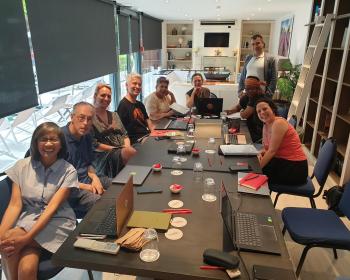
APC members elected a new board of directors for the world’s oldest online network during a ballot at the eleventh face-to-face APC council meeting on March 20.
I Can Stalk U - Raising awareness about inadvertent information sharing
The aptly named icanstalku.com attempts to expose the dangers inherent in posting information — in this case pictures — online in a rather unconventional way: the site regularly updates its news feed with individuals’ user names and locations, all gleaned from photos posted to Twitter.
New website helps transition to digital broadcasting in Africa
African countries have committed to migrating to digital broadcasting by June 2015. It will be a costly process and it is not clear who will benefit — or where the resources needed to make the transition will come from. A new website provides independent information for policy-makers about making the transition and reports on digital migration in Ghana, Nigeria and Senegal.
Brazil: High-speed connections reach marginalised people over the air
The problem of internet access in a country the size of Brazil is as complex as its geography or its population. The government is currently working on a national broadband plan which would establish high-speed fibre optic connections in the major cities. In order to reach the most distant towns, signals transmitted over the air will be used (through waves that circulate on a set frequency or spectrum). In this article we will review the trends in Brazil regarding regulation of this resource.
Gender studies centre and women’s rights guide book launched in Cambodia
An unprecedented achievement for the study and prevention of further violence against women in Cambodia was announced last month with the opening of a Women and Gender Studies Centre in the capital city Phnom Penh.
New online guide for using Web 2.0 tools to link research and policy
Fundación Comunica and APC have launched the Impact 2.0 iGuide: New mechanisms for linking research and policy, a guide designed to help researchers identify the right Web 2.0 tools for establishing links with policy makers, for building their online presence and credibility and for effectively communicating their research.
Pirated DVDs in a South African township mean access to culture and social inclusion
Although the political significance of piracy as a form of rebellion in South Africa has mostly dropped away in the post-Apartheid era, “the sharply racialised patterns of inequality and access to media have not,” says a new book that looks at the prevalence of media piracy, how it is organised, and why people buy pirated goods or work in the black market. The book collects case studies from various countries including a chapter on South Africa by APC. The case study of Hanover Park, a township outside Cape Town, reveals that watching pirated films brings families together. And more importantly, allows people with limited means the opportunity to access information and culture they would otherwise not be able to afford, bridging the social gap between the different social classes and making them be a part of a global conversation.
Media Piracy in South Africa
Poverty and social inequity in South Africa have shaped the development of media culture and distribution in the country. Low incomes in a country where one-third of the population lives on less than one dollar a day, high prices for commercial DVDs and Cds and a widespread advertising culture have created a high demand for media goods which are not easily obtained legally for the great majority of South Africans. Making pirated disks, books and online digital formats the desirable alternative. A new study on media piracy Media Piracy in Emerging Economies examines why piracy has come to be so widespread world-wide, the reasons why it persists and looks at the future. APC is the contributor for the South African chapter.
APC chosen once again as eLAC2015 liaison
Various social organisations that have been working together since 2005 to shape the information society in Latin America and the Caribbean have once again chosen APC to act as the civil society liaison within the eLAC2015 Plan of Action. Latin American and Caribbean governments in the Third Ministerial Conference on the Information Society approved the plan in November 2010.
Eleven tips for opening up the spectrum
Most communications policies around the globe have been developed on models based on the economic, political and social realities of North America and Europe – which assume large private companies build expansive national wired infrastructures. So laws and regulations have evolved with the understanding that these wired networks are the main communication infrastructure and that wireless networks connect through them. But wired networks do not exist in many developing countries and do not necessarily need to be built.
South Africa: Untapped TV spectrum can make internet more affordable
“Open spectrum is important because access is important” says Steve Song, telecommunications fellow at the Shuttleworth Foundation in an interview with APCNews. But in South Africa, the problem is not lack of access – it’s that access is not affordable. Freeing up wireless spectrum, such as television white spaces —the space between channels— or making more information available on spectrum that is currently not in use could help to make affordable access a reality. Song is the author of a new country survey report commissioned by APC in which he explores how spectrum is currently managed in South Africa, and the barriers that are blocking availability.
India's untapped potential: Are a billion people losing out because of spectrum?
As one of the world’s fastest growing economies and with over 65% of its billion-plus population under 35, India has huge potential. But according to a new report by Shyam Ponappa, commissioned by APC the current model for managing spectrum in India could be a huge barrier to the country’s economic and social development. Instead, he suggests that “it would be much more conducive to a sound economy…to have two to three main operators as we do with the provision of utilities.
I don't forward violence! Take a stand and join the campaign
Boyfriends and girlfriends rarely make commitments and plans to delete private photographs of each other when they snap them. What happens when the relationship breaks down and one of them decides to post them online? What about the people who receive and forward the images and videos? In each act of viewing and forwarding, they are continuing and replicating the violence. APC is launching a new campaign to stop the spread of violence by committing not to forward abusive messages. We invite you to take a stand.
Women's rights and realities transformed by technology
Can information and communication technologies (ICTs) transform women’s realities? Undoubtedly, yes. This connection between ICTs and the advancement of women’s rights will be addressed during the 55th session of the Commission on the Status of Women (CSW) 22 February – 4 March in New York. The CSW is a global policy-making body of the United Nations dedicated to gender equality and the advancement of women. APC’s GenderIT.org has released a special edition that speaks directly to this year’s theme of the CSW: gender, education and technology. APC staff attending the CSW will provide live coverage from the session in GenderIT.org’s Feminist Talk section on the website, so stay tuned.